
UK Road Signs Quiz: Free Visual Practice
Take this UK road signs quiz to practise recognising common British traffic signs. Answer ten original, illustrated questions, check each explanation and learn the difference between signs that give orders, warn of danger or provide information. Use the current Highway Code to confirm any rule before driving.
Independent DiuMitra revision for England, Scotland and Wales. Not an official DVSA examination or substitute for the current Highway Code.
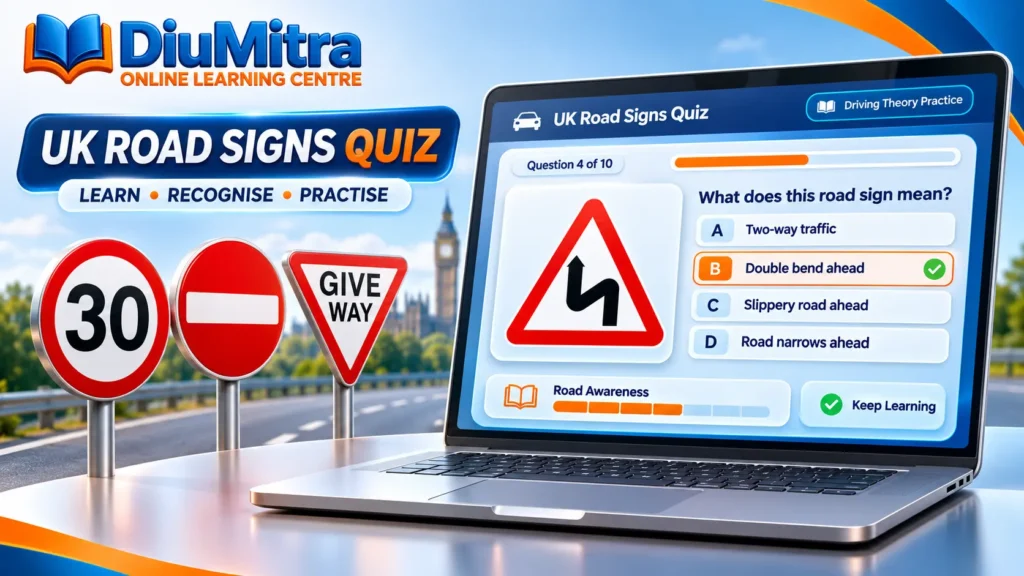
Start the Free UK Road Signs Quiz
Begin with ten illustrated road-sign questions. Select the meaning you think is correct, read the explanation, then move to the next sign. Your answers stay in this browser session; the short practice does not ask for an account.
What does this sign mean?
If the quiz does not load, please use the official Highway Code traffic signs guide or explore the DiuMitra visual sign library below.
How to Read UK Road Signs
The UK signing system groups signs by the job they do: giving orders, warning of hazards or supplying information. Understanding the basic shapes makes it easier to interpret unfamiliar signs.
Circles give orders
Red rings usually indicate a restriction or prohibition. Blue circles generally give a positive instruction, such as going ahead only or using a specified route.
Triangles warn
Red-bordered triangular signs generally alert you to hazards such as traffic signals, bends or junctions. Look at the symbol and respond to conditions safely.
Rectangles inform
Rectangular signs commonly give information or directions. Colours can also matter: motorway directions use blue signs, and primary routes use green.
More Road Signs, Signals and Markings
After the ten-question starter, explore the DiuMitra visual sign library and any available topic assessment. The independent starter above remains usable even when the extended reference collection is unavailable.
Road Signs, Signals & Markings
Learn from governed Highway Code visual assets, then use visual self-check and the full topic assessment.
Leave motorway at next exit
Governed local copy
Open related Highway Code reference
Signals to other road users
Governed local copy
Open related Highway Code reference


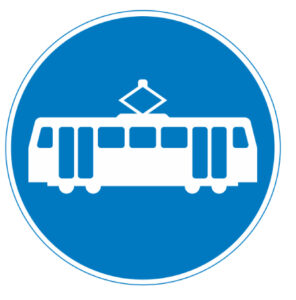


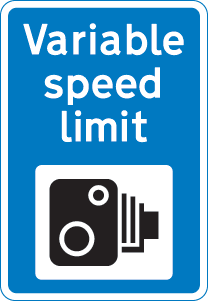

Complete official reference
The Highway Code
England, Scotland and Wales · governed DiuMitra reference copy
Rule 5
Organised walks or parades involving large groups of people walking along a road should use a pavement if available; if one is not available, they should keep to the left. Look-outs should be positioned at the front and back of the group, and they should wear fluorescent clothes in daylight and reflective clothes in the dark. At night, the look-out in front should show a white light and the one at the back a red light. People on the outside of large groups should also carry lights and wear reflective clothing.
Rule 6
Motorways. Pedestrians MUST NOT be on motorways or slip roads except in an emergency (see Rules 272 and 277).
Laws RTRA sect 17, MT(E&W)R reg 15(1)(b) & MT(S)R reg 13
Crossing the road (rules 7 to 17)
Rule 7
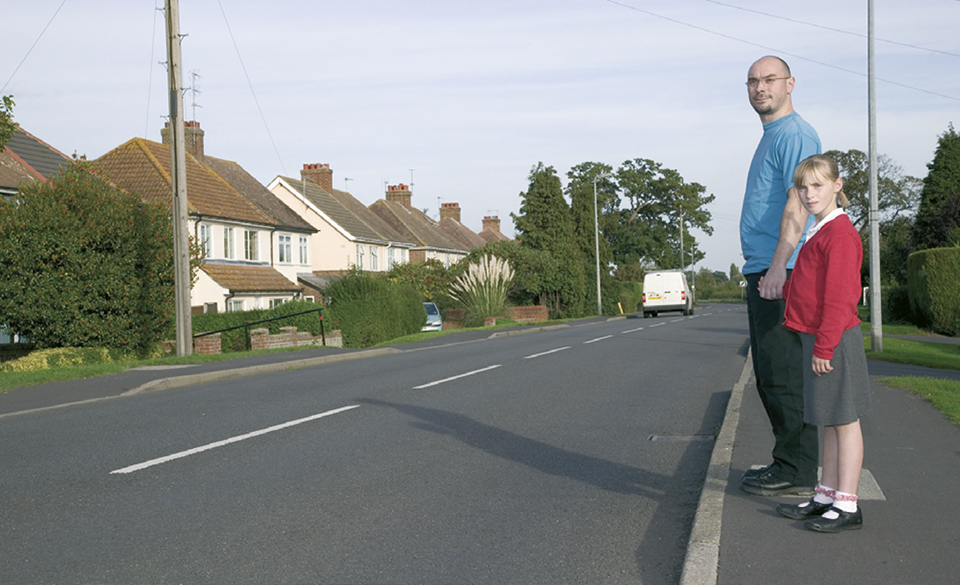
The Green Cross Code. The advice given below on crossing the road is for all pedestrians. Children should be taught the Code and should not be allowed out alone until they can understand and use it properly. The age when they can do this is different for each child. Many children cannot judge how fast vehicles are going or how far away they are. Children learn by example, so parents and carers should always use the Code in full when out with their children. They are responsible for deciding at what age children can use it safely by themselves.
A First find a safe place to cross and where there is space to reach the pavement on the other side. Where there is a crossing nearby, use it. It is safer to cross using a subway, a footbridge, an island, a zebra, pelican, toucan or puffin crossing, or where there is a crossing point controlled by a police officer, a school crossing patrol or a traffic warden. Otherwise choose a place where you can see clearly in all directions. Try to avoid crossing between parked cars (see Rule 14), on a blind bend, or close to the brow of a hill. Move to a space where drivers and riders can see you clearly. Do not cross the road diagonally.
Rule 8
At a junction. When you are crossing or waiting to cross the road, other traffic should give way. Look out for traffic turning into the road, especially from behind you, and cross at a place where drivers can see you. If you have started crossing and traffic wants to turn into the road, you have priority and they should give way (see Rules H2 and 170).
Rule 9
Pedestrian Safety Barriers. Where there are barriers, cross the road only at the gaps provided for pedestrians. Do not climb over the barriers or walk between them and the road.
Rule 10
Tactile paving. Raised surfaces that can be felt underfoot provide warning and guidance to blind or partially sighted people. The most common surfaces are a series of raised studs, which are used at crossing points with a dropped kerb, or a series of rounded raised bars which are used at level crossings, at the top and bottom of steps and at some other hazards.
Rule 11
One-way streets. Check which way the traffic is moving. Do not cross until it is safe to do so without stopping. Bus and cycle lanes may operate in the opposite direction to the rest of the traffic.
Rule 12
Bus and cycle lanes. Take care when crossing these lanes as traffic may be moving faster than in the other lanes, or against the flow of traffic.
Rule 13
Routes shared with cyclists. Cycle tracks may run alongside footpaths or pavements and be separated from them by a feature such as a change of material, a verge, a kerb or a white line. Such routes may also incorporate short lengths of tactile paving to help visually impaired people stay on the correct side. On the pedestrian side this may comprise a series of flat-topped bars running across the direction of travel (ladder pattern). On the cyclist side the same bars are orientated in the direction of travel (tramline pattern).
Some routes shared with cyclists will not be separated by such a feature allowing cyclists and pedestrians to share the same space. Cyclists should respect your safety (see Rule 62) but you should also take care not to obstruct or endanger them. Always remain aware of your environment and avoid unnecessary distractions.
Where signs indicate, some routes are shared between pedestrians, cyclists, horse riders and horse drawn vehicles. Cyclists, horse riders and drivers of horse drawn vehicles should respect your safety, but you should take care not to obstruct or endanger them. Always remain aware of your environment and avoid unnecessary distractions.
Rule 14
Parked vehicles. If you have to cross between parked vehicles, use the outside edges of the vehicles as if they were the kerb. Stop there and make sure you can see all around and that the traffic can see you. Make sure there is a gap between any parked vehicles on the other side, so you can reach the pavement. Never cross the road in front of, or behind, any vehicle with its engine running, especially a large vehicle, as the driver may not be able to see you.
Rule 15
Reversing vehicles. Never cross behind a vehicle which is reversing, showing white reversing lights or sounding a warning.
Rule 16
Moving vehicles. You MUST NOT get onto or hold onto a moving vehicle.
Law RTA 1988 sect 26
Rule 17
At night. Wear something reflective to make it easier for others to see you (see Rule 3). If there is no pedestrian crossing nearby, cross the road near a street light so that traffic can see you more easily.
Crossings (rules 18 to 30)
Rule 18
At all crossings. When using any type of crossing you should
- always check that the traffic has stopped before you start to cross or push a pram onto a crossing
- always cross between the studs or over the zebra markings. Do not cross at the side of the crossing or on the zig-zag lines, as it can be dangerous.
You MUST NOT loiter on any type of crossing.
Laws TSRGD Schedule 14 part 5 and RTRA sect 25(5)
Rule 19
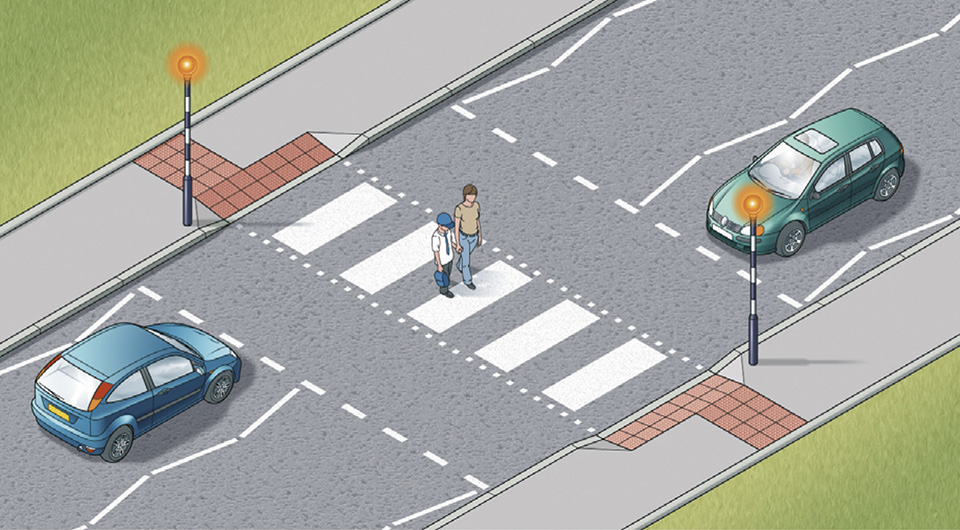
Zebra crossings. Give traffic plenty of time to see you and to stop before you start to cross. Vehicles will need more time when the road is slippery. Wait until traffic has stopped from both directions or the road is clear before crossing. Remember that traffic does not have to stop until someone has moved onto the crossing. Drivers and riders should give way to pedestrians waiting to cross and MUST give way to pedestrians on a zebra crossing (see Rule H2). Keep looking both ways, and listening, in case a driver or rider has not seen you and attempts to overtake a vehicle that has stopped.
Rule 21
At traffic lights. There may be special signals for pedestrians. You should only start to cross the road when the green figure shows. If you have started to cross the road and the green figure goes out, you should still have time to reach the other side, but do not delay. If no pedestrian signals have been provided, watch carefully and do not cross until the traffic lights are red and the traffic has stopped. Keep looking and check for traffic that may be turning the corner. Remember that traffic lights may let traffic move in some lanes while traffic in other lanes has stopped.
Rule 22
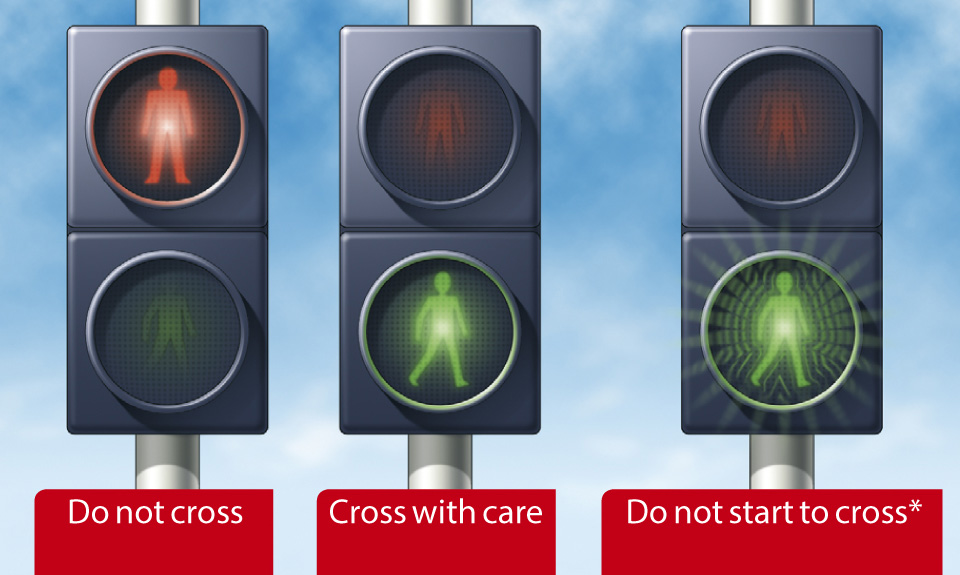
Pelican crossings. These are signal-controlled crossings operated by pedestrians. Push the control button to activate the traffic signals. When the red figure shows, do not cross. When a steady green figure shows, check the traffic has stopped then cross with care. When the green figure begins to flash you should not start to cross. If you have already started you should have time to finish crossing safely.
Rule 23
Puffin crossings differ from pelican crossings as the red and green figures are above the control box on your side of the road and there is no flashing green figure phase. Press the button and wait for the green figure to show.
Rule 24
When the road is congested, traffic on your side of the road may be forced to stop even though their lights are green. Traffic may still be moving on the other side of the road, so press the button and wait for the signal to cross.
Rule 25
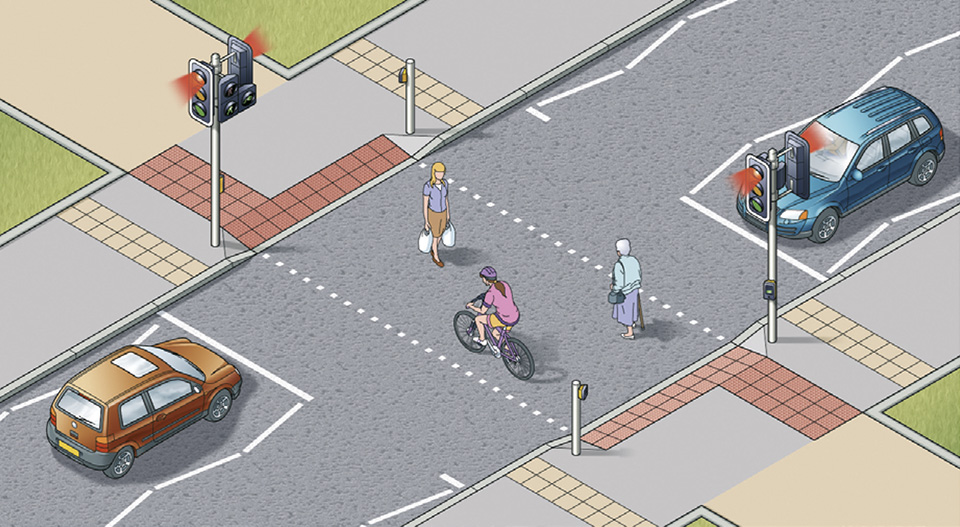
Toucan crossings are light-controlled crossings which allow cyclists and pedestrians to share crossing space and cross at the same time. They are push-button operated. Pedestrians and cyclists will see the green signal together. Cyclists are permitted to ride across.
Rule 26
At some crossings there is a bleeping sound or voice signal to indicate to blind or partially sighted people when the steady green figure is showing, and there may be a tactile signal to help deafblind people.
Rule 27
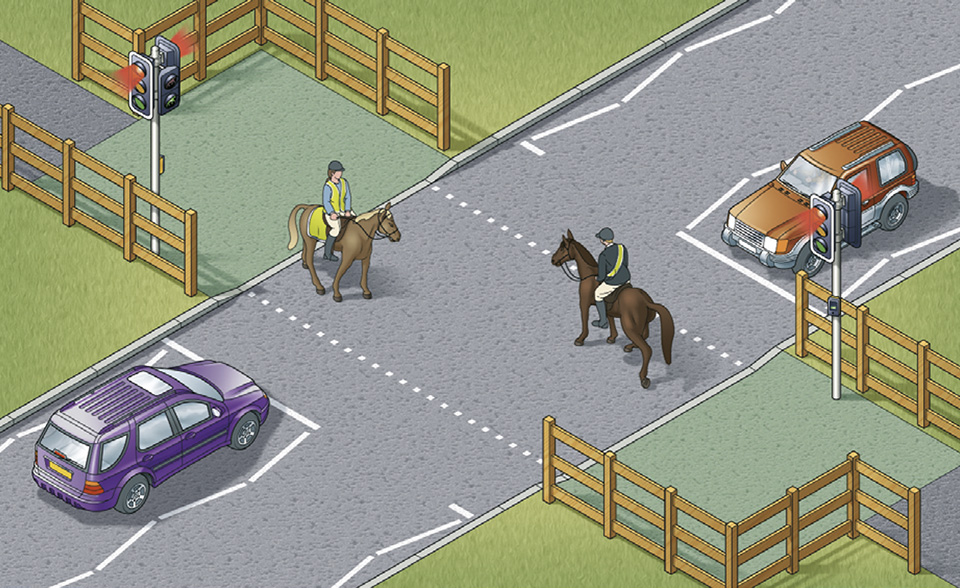
Equestrian crossings are for horse riders. They have pavement barriers, wider crossing spaces, horse and rider figures in the light panels and either two sets of controls (one higher), or just one higher control panel.
Rule 28
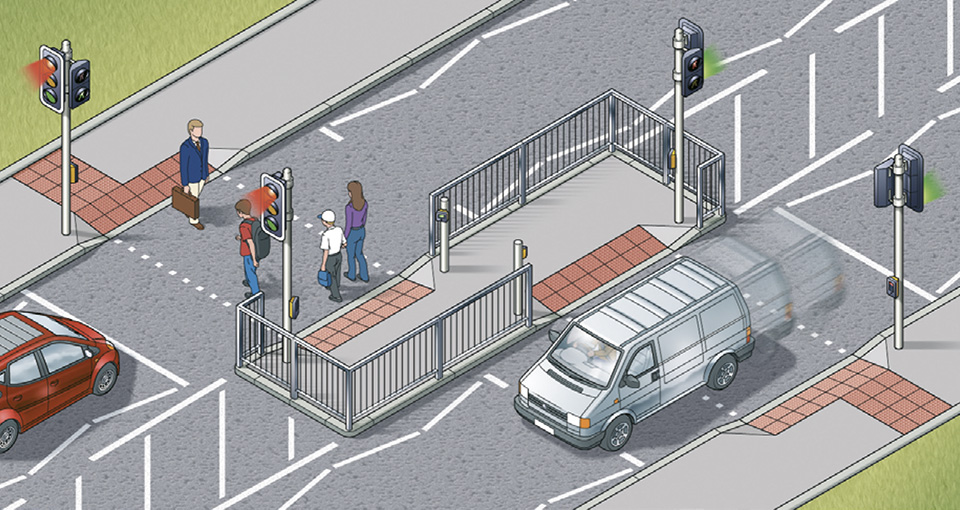
Staggeredâ pelican or puffin crossings. When the crossings on each side of the central refuge are not in line they are two separate crossings. On reaching the central island, press the button again and wait for a steady green figure.
Rule 29
Crossings controlled by an authorised person. Do not cross the road unless you are signalled to do so by a police officer, traffic warden or school crossing patrol. Always cross in front of them.
Rule 30
Where there are no controlled crossing points available it is advisable to cross where there is an island in the middle of the road. Use the Green Cross Code (see Rule 7) to cross to the island and then stop and use it again to cross the second half of the road.
Situations needing extra care (rules 31 to 35)
Rule 31
Emergency vehicles. If an ambulance, fire engine, police or other emergency vehicle approaches using flashing blue lights, headlights and/or sirens, keep off the road.
Rule 32
Buses. Get on or off a bus only when it has stopped to allow you to do so. Watch out for cyclists when you are getting off. Never cross the road directly behind or in front of a bus. Wait until it has moved off and you can see clearly in both directions.
Rule 33
Tramways. These may run through pedestrian areas. Their path will be marked out by shallow kerbs, changes in the paving or other road surface, white lines or yellow dots. Cross at designated crossings where provided. Elsewhere treat trams as you would other road vehicles and look both ways along the track before crossing. Do not walk along the track as trams may come up behind you. Trams move quietly and cannot steer to avoid you.
Rule 34
Railway level crossings. You MUST NOT cross or pass a stop line when the red lights show, (including a red pedestrian figure). Also do not cross if an alarm is sounding or the barriers are being lowered. The tone of the alarm may change if another train is approaching. If there are no lights, alarms or barriers, stop, look both ways and listen before crossing. A tactile surface comprising rounded bars running across the direction of pedestrian travel may be installed on the footpath approaching a level crossing to warn visually impaired people of its presence. The tactile surface should extend across the full width of the footway and should be located at an appropriate distance from the barrier or projected line of the barrier.
Rule 35
Street and pavement repairs. A pavement may be closed temporarily because it is not safe to use. Take extra care if you are directed to walk in or to cross the road.
Road signs topic test
Road and traffic signs — Topic Practice
If the extended sign collection is unavailable, continue with the official Highway Code traffic signs reference while the learning catalogue is updated.
Road Signs People Commonly Confuse
Several signs can appear similar at first glance. In the quiz, read the shape, colour, symbol and any words or plates rather than guessing from one feature.
No waiting vs no stopping
The red diagonal line through a blue circle means no waiting; a red X means no stopping. Check nearby plates and road markings for the full restriction.
Ahead only vs one way
A white upward arrow inside a blue circle gives an ahead-only instruction. The arrow inside a blue rectangle indicates one-way traffic.
No entry vs give way
No Entry restricts vehicular entry. Give Way means approaching traffic on the major road has priority; you may need to stop before proceeding.
How to Practise Road Signs Effectively
Try a short focused session, understand mistakes immediately and return to official sources. DiuMitra’s starter activity does not grade your readiness for the real driving theory test.
Look at the whole sign
Notice whether the sign is circular, triangular or rectangular. Check the symbol, numbers and any additional text beneath it.
Choose the best meaning
Select one answer without looking it up first. The activity shows an explanation and identifies the correct answer after you choose.
Review and repeat
Use the Highway Code when uncertain, especially for restrictions and exceptions. Repeat the quiz to check whether the explanations make sense.
UK Road Sign Categories at a Glance
Signs work together with road markings, signals and supplementary plates. This overview helps you decide which official section to study next.
| Type of sign | What it generally tells you | Typical examples |
|---|---|---|
| Regulatory / order signs | What you must do, or what you must not do | STOP, Give Way, No Entry, maximum speed, Ahead Only |
| Warning signs | Hazards or road conditions to anticipate | Traffic signals ahead, bends, junctions |
| Direction and information signs | Routes, destinations, road layout or facilities | One-way traffic, direction boards, motorway information |
| Supplementary plates | Extra details that qualify a main sign | Times, distances, vehicle restrictions |
| Road markings and signals | Additional instructions or information on the road | Stop lines, lane arrows, traffic lights |
Official UK Road Signs and Revision Resources
This quiz uses original schematic sign drawings and independently written explanations based on published traffic-sign guidance. Signs, restrictions and test arrangements can change, so the official guidance remains the source for current requirements.
For learner drivers
Build visual recognition alongside the wider road rules, observations and safe decision-making needed for the GB car theory test. Traffic signs are one topic within the overall assessment.
Continue with Driving Theory Practice Tests and Driving Theory Study Course lessons.
For road users refreshing their knowledge
Use the quiz to recognise sign meanings, then check official explanations. Never assume an image alone gives every detail of a road restriction; signs may be paired with plates, road markings or location-specific arrangements.
Northern Ireland has its own official arrangements and some differences. Follow the relevant local authority guidance.
UK Road Signs Quiz FAQs
Clear answers about signs, free practice, official study material and how DiuMitra’s activities differ from a real driving theory examination.
Recognise the Sign. Understand the Rule.
Start the free visual road signs quiz, check unfamiliar signs against official guidance and continue with Driving Theory Practice Tests when you are ready. Consistent revision matters more than memorising one set of answers.
DiuMitra provides independent learning resources only. This quiz is not an official DVSA examination, and it does not guarantee a theory test pass.