
Maths Games for Kids: Play, Count & Learn
Maths games for kids can make counting, number bonds and multiplication more approachable through short, hands-on activities. Try three free mini-games on this page, choose questions that suit the child’s current skills and explore additional Maths Adventure activities in DiuMitra’s learning portal when available. Parents and carers can support every step.
Play the on-page mini-games without creating an account. Answers and scores stay in this browser page and are not saved to a child profile.
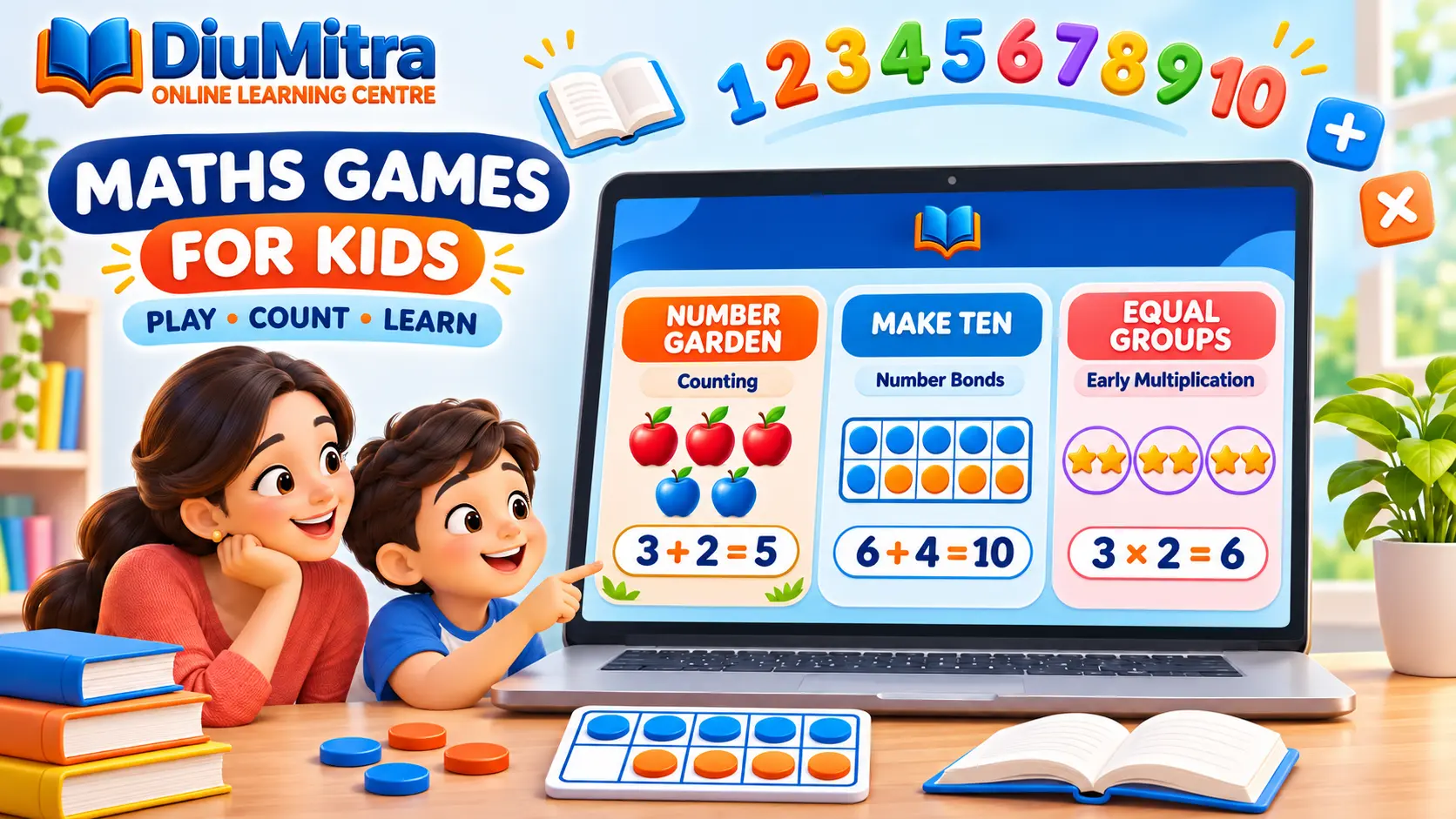
Learn Maths Through Short, Visible Activities
Children can start with quantities they can see, explain their thinking and move on to more complex number facts when ready.
A short game can help a child connect numbers to objects, groups and everyday situations. Counting supports early number sense; number bonds help addition and subtraction; and equal groups prepare children for multiplication. These are teaching examples rather than assessments of a child’s attainment.
England’s primary mathematics curriculum includes counting, place value, number bonds, the four operations, fractions, shapes and measures. Activity choice should follow the child’s understanding rather than age alone.
Which Maths Skills Can Children Practise?
Explore familiar early number skills and other Maths Adventure themes. The three games below are immediately playable; additional portal activities depend on availability and access.
Number Garden
Spot quantities, count forwards and backwards, and recognise one more or one less.
Number Bonds Builder
Find the missing number that makes ten, with supportive counters and clear feedback.
Times Tables Challenge
Build multiplication confidence using equal groups and repeated addition.
Fractions and Sharing
Explore halves, quarters and equal sharing when the child is ready for these ideas.
Money and Measures
Use pretend shopping, prices, clocks and measurements to connect maths with daily life.
Shapes and Patterns
Talk about simple shapes, repeating patterns and the properties children notice.
Play Three Free Maths Mini-Games
Choose a maths skill, answer six short questions and read a simple explanation after every answer. Nothing is timed or saved.
Choose a mini-game
What is one more than 3?
The games need JavaScript. If answer buttons do not appear, enable JavaScript in your browser or ask an adult to help.
Free unsaved practice. No timer, no personal information, no leaderboard and no automatic progress record. An adult can help read the question and talk through a mistake.
These three short activities are original DiuMitra examples. Additional games such as Fraction Kitchen, Money Shop and Measurement Mission are delivered through Maths Adventure in the learning portal; availability, sign-in and guardian permissions can differ.
Which Game Should Your Child Try First?
Start with what the child can explain using counters, drawings or familiar examples. Move forward when the idea is understood, not because the next game looks harder.
| Skill | Learning goal | Suggested activity | When to try |
|---|---|---|---|
| Counting and comparing | Recognising quantities, one more and one less | Number Garden | Early number understanding |
| Addition and subtraction | Pairs that make 10 and simple inverse facts | Make Ten | When the child can count objects reliably |
| Multiplication | Equal groups and repeated addition | Equal Groups | After basic addition is understood |
| Later concepts | Fractions, money, shapes and measurement | Maths Adventure activities | When the relevant earlier idea is familiar |
How to Make Maths Practice Fun and Useful
Use one short game and one real-world example. A calm explanation is more useful than rushing through questions.
Choose a Skill
Begin with counting, number bonds or equal groups. A parent can read the question aloud when helpful.
Try and Explain
Choose an answer, look at the feedback and use fingers, counters or drawings to show why it works.
Repeat in Real Life
Count shopping items, make number pairs with toys or build equal groups using buttons or blocks.
Three Simple Maths Games to Try at Home
Use ordinary objects to help children see numbers as quantities, not just symbols on a screen.
Count Your Toys
Line up six toys, ask what happens if one is added or removed, and say the new number aloud.
Make Ten Together
Place ten objects on the table, cover some with a cloth and work out how many are hidden.
Build Equal Groups
Create three groups of four buttons, count all twelve, then turn the groups into a multiplication statement.
Privacy, Guardian Support and Learning Boundaries
The three mini-games on this page run locally in the browser and do not ask for names, age, email addresses or account details.
These mini-games do not transmit answers to DiuMitra, create a child profile or store a scoreboard. Closing or reloading the page resets the activity. The separate Maths Adventure portal may offer more detailed learning sessions subject to account and guardian controls.
This is independent educational practice, not a school examination or a guarantee of curriculum attainment. Parents should check whether an activity suits their child and can refer to the England mathematics curriculum for official programmes of study.
Maths Games for Kids FAQs
Clear answers for parents and carers about cost, levels, privacy, learning progress and access to more activities.
Make Maths a Small Part of Every Day
Return to the free number games whenever you like, or explore the wider DiuMitra Kids Learning hub for other activities. Parents and carers can contact our team for help finding the appropriate learning section.
Always supervise younger learners and review any portal access conditions before using child accounts.