
Driving Theory Study Course: Learn GB Road Rules
A driving theory study course helps learner car drivers in Great Britain understand road rules before taking practice tests. Explore signs, road-user priorities, safe driving decisions, motorways, vehicle safety and hazard awareness through structured study topics. Read the current official materials alongside your lessons, then test your knowledge separately.
Independent learning for the Great Britain car theory test — not an official DVSA course or examination. Check the course catalogue for availability and access terms.
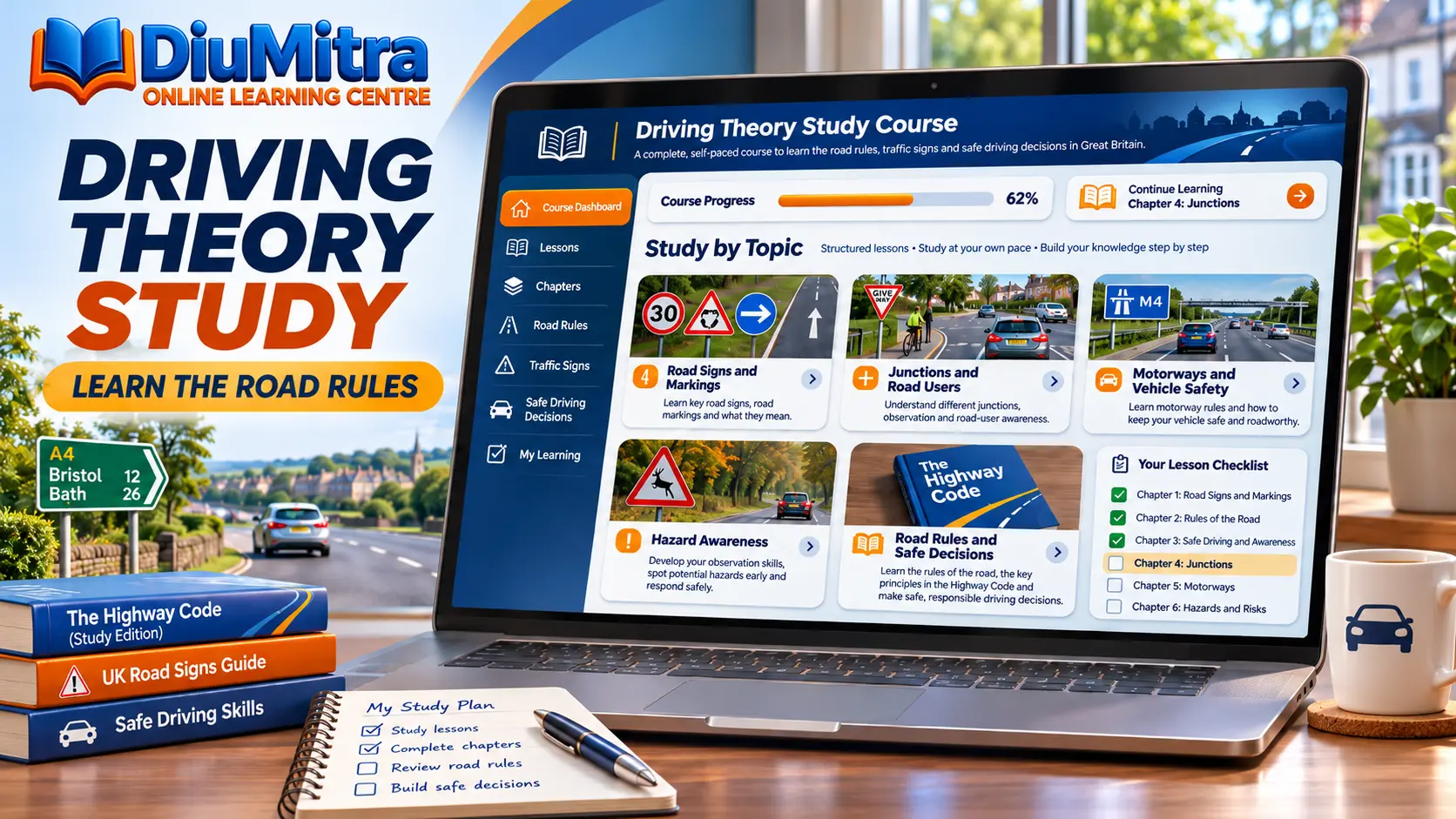
A Driving Theory Study Course Built Around Understanding
Learn how to reason about safe driving situations rather than memorising answers without context.
The official Great Britain car theory multiple-choice questions draw on The Highway Code, Know Your Traffic Signs and Driving – The Essential Skills. Use those three resources to check current rules and explanations while following your independent lesson plan.
This study page is for learner car drivers preparing in England, Scotland and Wales. Northern Ireland has separate arrangements through the Driver & Vehicle Agency, so use official Northern Ireland theory-test information where applicable.
Begin with one topic, study examples of real-world decisions, then use the separate Driving Theory Practice Tests page for assessment practice and answer explanations. This keeps guided lessons and test-taking in distinct sections.
Four Connected Study Units for GB Car Theory
These four learning units take you from the basics of road safety to more complex decisions and final revision. Check the current course listing for the exact published lessons and access options.
Start and Study Safely
Understand the two parts of the car theory test and how to build a realistic learning routine using current official material.
Road Users, Signs and Decisions
Study the road-user hierarchy, traffic signs, choosing speed, junctions, crossings, observation and road positioning.
Complex Journeys and Vehicle Safety
Learn principles for motorway journeys, difficult weather, vehicle checks, driver fitness, incidents and breakdowns.
Hazard Awareness and Final Revision
Understand developing hazards, plan an effective mock-test review and apply lessons to a journey-based case study.
What to Focus on During Your Driving Theory Study
The following subject groups help you organise revision; they are not a prediction of the questions you will receive in the official test.
Road Signs and Markings
Learn to distinguish signs that give orders, warn of hazards or provide directions and information. Practise reading the whole road scene rather than relying on colour alone.
Vulnerable Road Users
Build awareness of pedestrians, cyclists, horse riders and motorcyclists. Understand why drivers who can cause greater harm have greater responsibility to reduce danger.
Junctions and Crossing Decisions
Study observation, mirrors, safe gaps and how pedestrians and cyclists affect turning and crossing decisions. Use the official Code to review give-way rules.
Speed, Space and Conditions
Understand why the posted speed limit is not always a safe driving speed. Revise stopping space, visibility and changing weather conditions.
Motorways and Breakdowns
Prepare to recognise motorway signs, joining and leaving procedures, lane discipline and safe responses to vehicle trouble.
Hazard Awareness
Learn the difference between a potential hazard and one that is developing. Use authorised hazard-perception resources for realistic timed clip practice.
Sample Lesson: Make a Safer Junction Decision
This short original example demonstrates the course’s learning-first approach. It is not an official DVSA lesson or a driving instruction substitute.
Mini lesson: Look beyond the vehicle directly ahead
Imagine you are approaching a side road and preparing to turn. You notice a pedestrian waiting to cross the road you intend to enter, while a cyclist is moving along your left side. A safe decision starts with observing both people, reducing your speed and checking whether your intended movement would put anyone at risk.
The Highway Code tells turning drivers they should give way to pedestrians who are crossing or waiting to cross the road into which or from which they are turning. It also stresses the importance of not cutting across cyclists when changing direction. You must assess the actual road conditions before making a manoeuvre.
- Observe: check mirrors and blind spots, including the movements of other road users.
- Interpret: identify the relevant rules and whether someone may move into your path.
- Decide: slow down, give way where required and move only when safe.
- Review: consult the current Highway Code rules when you are uncertain.
Read the official using-the-road guidance and road users requiring extra care for the detailed requirements.
Three Quick Driving Theory Learning Checks
Try explaining each answer in your own words before opening the explanation. These are untimed study prompts, not official examination questions.
Learning check 1
Why should you check for cyclists before changing direction?
Show explanation
Cyclists may be alongside your vehicle or in a blind spot. A driver should observe carefully and avoid cutting across their path.
Learning check 2
Can a posted speed limit always be treated as the safest speed?
Show explanation
No. Weather, visibility, traffic, road layout and other hazards can require you to drive more slowly than the limit.
Learning check 3
How is a developing hazard different from a potential hazard?
Show explanation
A developing hazard is beginning to require a response, such as adjusting speed or direction. An object or road user that does not yet affect your journey may be only a potential hazard.
A Simple Three-Step Theory Revision Routine
Short, purposeful study sessions can help you connect the written rules with decisions you might face on the road.
Read the source
Choose one unit and read the relevant Highway Code or traffic-sign guidance. Notice words such as MUST and should.
Explain the decision
Write one example in plain English: what can happen, who is at risk and what makes a safe action?
Test and revisit
Use free car theory practice questions to check recall. Review mistakes and return to the corresponding rules before trying another set.
Study Lessons, Mock Tests and Official Resources
The study course and the practice-test pages answer different questions. Use the comparison below to pick the right resource for each stage.
| Learning resource | What it helps you do | When to use it |
|---|---|---|
| Driving Theory Study Course | Understand and revise road rules, safety reasoning and realistic decisions. | First, and whenever an explanation needs another look. |
| Driving Theory Practice Tests | Apply knowledge to questions, review answers and identify weaker subjects. | After studying topics and during final revision. |
| Official DVSA resources | Review authoritative topics, official revision materials and current test information. | Throughout your learning journey. |
| Official GB car theory test | Take the regulated multiple-choice and hazard-perception assessments. | When ready, through the official booking service. |
Official GB Car Theory Test Format
Understanding the test format helps you plan revision, but the course does not replace the real examination.
What the official GB car theory test involves
The car theory test has a 50-question multiple-choice section with 57 minutes available. You need at least 43 correct answers in that section, and you must also pass hazard perception with at least 44 points out of 75.
The hazard-perception part shows 14 clips, including one clip with two developing hazards. Those official test details are provided as context; this course page is for studying, not for scoring or booking an examination.
Multiple-choice
50 questions · 57 minutes · 43/50 pass threshold
Hazard perception
14 video clips · 44/75 pass threshold
Official multiple-choice format · Official hazard-perception format
How to Start Studying With DiuMitra
Check the current course listing for available learning materials. This page does not guarantee a free place, paid entitlement, certificate or completion outcome.
Find the currently available driving-theory lessons
Open DiuMitra’s self-paced course catalogue and locate the GB car-theory learning programme. The available lessons and any free or premium access terms depend on the published course release.
- Confirm the lesson list and course availability before registering.
- Review any account, enrolment and payment requirements on the course listing.
- Use the learner portal to resume lessons where course progress is enabled.
- Keep the official DVSA and Highway Code materials open for authoritative reference.
Official Driving Theory Study Materials
The DVSA identifies three core sources for car-theory multiple-choice revision: The Highway Code, Know Your Traffic Signs and Driving – The Essential Skills.
Check current rules with official sources
Use the authoritative materials throughout your preparation. Rules and test requirements can change, so review the current versions rather than relying on old screenshots or memorised question answers.
DiuMitra is an independent learning resource and is not affiliated with the DVSA, DVA or GOV.UK. This page is not a substitute for supervised practical driving lessons.
Driving Theory Study Course FAQs
Practical answers about learning the rules, access options and the difference between studying and taking the official GB car theory test.
Start With the Rules, Then Practise
Explore the currently available driving-theory lessons, then check your understanding with independent practice questions. Use the official DVSA resources whenever you need to verify a rule.
DiuMitra provides independent educational guidance and official-source signposting. It does not administer official tests, provide a driving licence or guarantee exam results.