
UK Road Signs Quiz: Free Visual Practice
Take this UK road signs quiz to practise recognising common British traffic signs. Answer ten original, illustrated questions, check each explanation and learn the difference between signs that give orders, warn of danger or provide information. Use the current Highway Code to confirm any rule before driving.
Independent DiuMitra revision for England, Scotland and Wales. Not an official DVSA examination or substitute for the current Highway Code.
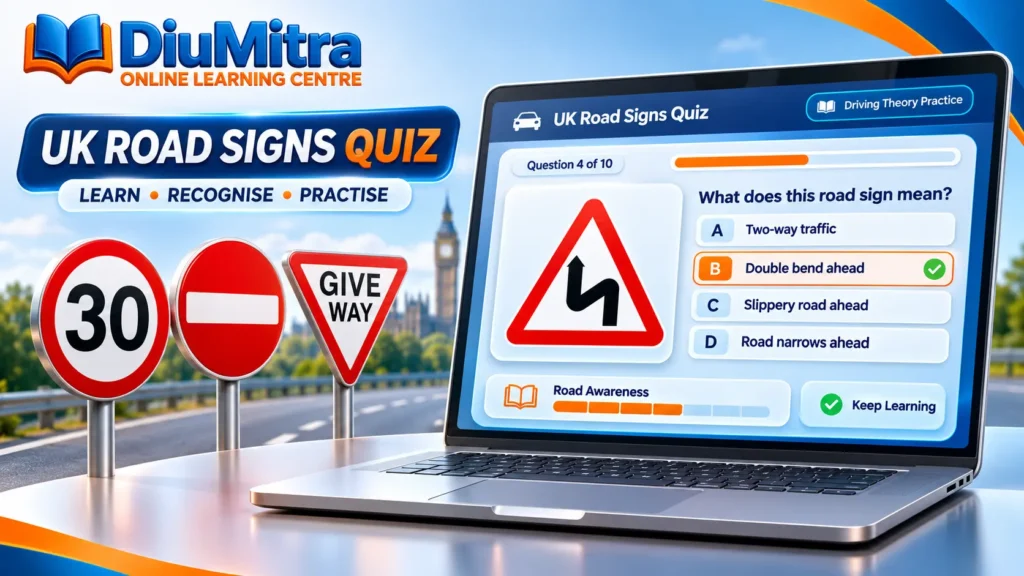
Start the Free UK Road Signs Quiz
Begin with ten illustrated road-sign questions. Select the meaning you think is correct, read the explanation, then move to the next sign. Your answers stay in this browser session; the short practice does not ask for an account.
What does this sign mean?
If the quiz does not load, please use the official Highway Code traffic signs guide or explore the DiuMitra visual sign library below.
How to Read UK Road Signs
The UK signing system groups signs by the job they do: giving orders, warning of hazards or supplying information. Understanding the basic shapes makes it easier to interpret unfamiliar signs.
Circles give orders
Red rings usually indicate a restriction or prohibition. Blue circles generally give a positive instruction, such as going ahead only or using a specified route.
Triangles warn
Red-bordered triangular signs generally alert you to hazards such as traffic signals, bends or junctions. Look at the symbol and respond to conditions safely.
Rectangles inform
Rectangular signs commonly give information or directions. Colours can also matter: motorway directions use blue signs, and primary routes use green.
More Road Signs, Signals and Markings
After the ten-question starter, explore the DiuMitra visual sign library and any available topic assessment. The independent starter above remains usable even when the extended reference collection is unavailable.
Road Signs, Signals & Markings
Learn from governed Highway Code visual assets, then use visual self-check and the full topic assessment.
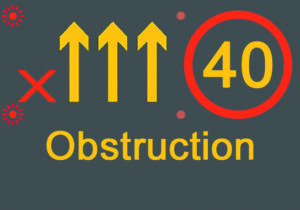
Leave motorway at next exit
Governed local copy
Open related Highway Code reference
Signals to other road users
Governed local copy
Open related Highway Code reference


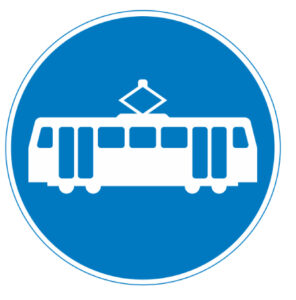


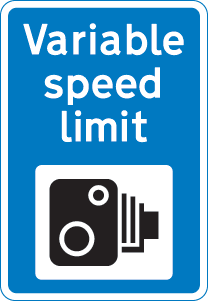

Complete official reference
The Highway Code
England, Scotland and Wales · governed DiuMitra reference copy
Rule 204
The road users most at risk from road traffic are pedestrians, in particular children, older adults and disabled people, cyclists, horse riders and motorcyclists. It is particularly important to be aware of children, older adults and disabled people, and learner and inexperienced drivers and riders. In any interaction between road users, those who can cause the greatest harm have the greatest responsibility to reduce the danger or threat they pose to others.
Pedestrians (rules 205 to 210)
Rule 205
There is a risk of pedestrians, especially children, stepping unexpectedly into the road. You should drive with the safety of children in mind at a speed suitable for the conditions.
Rule 206
Drive carefully and slowly when
- in crowded shopping streets, Home Zones and Quiet Lanes (see Rule 218) or residential areas
- driving past bus and tram stops; pedestrians may emerge suddenly into the road
- passing parked vehicles, especially ice cream vans; children are more interested in ice cream than traffic and may run into the road unexpectedly
- needing to cross a pavement, cycle lane or cycle track; for example, to reach or leave a driveway or private access. Give way to pedestrians on the pavement and cyclists using a cycle lane or cycle track
- reversing into a side road; look all around the vehicle and give way to any pedestrians who may be crossing the road
- turning at road junctions; you should give way to pedestrians who are crossing or waiting to cross the road into which or from which you are turning
- going through road works or when passing roadside rescue and recovery vehicles, as there may be people working in or at the side of the road
- the pavement is closed due to street repairs and pedestrians are directed to use the road
- approaching pedestrians on narrow rural roads without a footway or footpath. Always slow down and be prepared to stop if necessary, giving them plenty of room as you drive past
- approaching zebra and parallel crossings as you MUST give way to pedestrians and cyclists on the crossing (see Rule 195)
- approaching pedestrians who have started to cross the road ahead of you. They have priority when crossing at a junction or side road so you should give way (see Rule H2).

Rule 207
Particularly vulnerable pedestrians. These include:
- children and older pedestrians who may not be able to judge your speed and could step into the road in front of you. At 40 mph (64 km/h) your vehicle will probably kill any pedestrians it hits. At 20 mph (32 km/h) there is only a 1 in 20 chance of the pedestrian being killed. So kill your speed
- older pedestrians who may need more time to cross the road. Be patient and allow them to cross in their own time. Do not hurry them by revving your engine or edging forward
- people with disabilities. People with hearing impairments may not be aware of your vehicle approaching. Those with walking difficulties require more time
- blind or partially sighted people, who may be carrying a white cane using a guide dog. They may not be able to see you approaching
- deafblind people who may be carrying a white cane with a red band or using a dog with a red and white harness. They may not see or hear instructions or signals.
Rule 208
Near schools. Drive slowly and be particularly aware of young cyclists and pedestrians. In some places, there may be a flashing amber signal below the âSchoolâ warning sign which tells you that there may be children crossing the road ahead. Drive very slowly until you are clear of the area.
Rule 209
Drive carefully and slowly when passing a stationary bus showing a âSchool Busâ sign as children may be getting on or off.

Rule 210
You MUST stop when a school crossing patrol shows a âStop for childrenâ sign (see âSignals by authorised personsâ and âTraffic signsâ).
Law RTRA sect 28
Motorcyclists and cyclists (rules 211 to 213)
Rule 211
It is often difficult to see motorcyclists and cyclists, especially when they are waiting alongside you, coming up from behind, coming out of or moving off from junctions, at roundabouts, overtaking you or filtering through traffic. Always look out for them before you emerge from a junction; they could be approaching faster than you think.
Do not turn at a junction if to do so would cause the cyclist going straight ahead to stop or swerve, just as you would do with a motor vehicle.
When turning right across a line of slow-moving or stationary traffic, look out for and give way to cyclists or motorcyclists on the inside of the traffic you are crossing. Be especially careful when moving off, turning, and when changing direction or lane. Be sure to check mirrors and blind spots carefully.

Rule 212
Give motorcyclists, cyclists, horse riders, horse drawn vehicles and pedestrians walking in the road (for example, where there is no pavement), at least as much room as you would when overtaking a car (see Rules 162 to 167). Drivers should take extra care and give more space when overtaking motorcyclists, cyclists, horse riders, horse drawn vehicles and pedestrians in bad weather (including high winds) and at night. If the rider looks over their shoulder it could mean that they intend to pull out, turn right or change direction. Give them time and space to do so.
Rule 213
On narrow sections of road, on quiet roads or streets, at road junctions and in slower-moving traffic, cyclists may sometimes ride in the centre of the lane, rather than towards the side of the road. It can be safer for groups of cyclists to ride two abreast in these situations. Allow them to do so for their own safety, to ensure they can see and be seen. Cyclists are also advised to ride at least a doorâs width or 1 metre from parked cars for their own safety.
On narrow sections of road, horse riders may ride in the centre of the lane. Allow them to do so for their own safety to ensure they can see and be seen.
Motorcyclists, cyclists, horse riders and horse drawn vehicles may suddenly need to avoid uneven road surfaces and obstacles such as drain covers or oily, wet or icy patches on the road. Give them plenty of room and pay particular attention to any sudden change of direction they may have to make.
Other road users (rules 214 to 218)
Rule 214
Animals. When passing animals, drive slowly. Give them plenty of room and be ready to stop. Do not scare animals by sounding your horn, revving your engine or accelerating rapidly once you have passed them. Look out for animals being led, driven or ridden on the road and take extra care. Keep your speed down at bends and on narrow country roads. If a road is blocked by a herd of animals, stop and switch off your engine until they have left the road. Watch out for animals on unfenced roads.
Rule 215
Horse riders and horse-drawn vehicles. Be particularly careful of horse riders and horse-drawn vehicles especially when approaching, overtaking, passing or moving away. Always pass wide and slowly. When you see a horse on a road, you should slow down to a maximum of 10 mph. Be patient, do not sound your horn or rev your engine. When safe to do so, pass wide and slow, allowing at least 2 metres of space.
Feral or semi feral ponies found in areas such as the New Forest, Exmoor and Dartmoor require the same consideration as ridden horses when approaching or passing.
Horse riders are often children, so take extra care and remember riders may ride in double file when escorting a young or inexperienced horse or rider. Look out for horse ridersâ and horse driversâ signals and heed a request to slow down or stop. Take great care and treat all horses as a potential hazard; they can be unpredictable, despite the efforts of their rider/driver. Remember there are three brains at work when you pass a horse; the riderâs, the driverâs and the horseâs. Do not forget horses are flight animals and can move incredibly quickly if startled.
Rule 216
Older drivers. Their reactions may be slower than other drivers. Make allowance for this.
Rule 217
Learners and inexperienced drivers. They may not be so skilful at anticipating and responding to events. Be particularly patient with learner drivers and young drivers. Drivers who have recently passed their test may display a ânew driverâ plate or sticker (see âSafety code for new driversâ).
Rule 218
Home Zones and Quiet Lanes. These are places where people could be using the whole of the road for a range of activities such as children playing or for a community event. You should drive slowly and carefully and be prepared to stop to allow people extra time to make space for you to pass them in safety.

Other vehicles (rules 219 to 225)
Rule 219
Emergency and Incident Support vehicles. You should look and listen for ambulances, fire engines, police, doctors or other emergency vehicles using flashing blue, red or green lights and sirens or flashing headlights, or traffic officer and incident support vehicles using flashing amber lights. When one approaches do not panic. Consider the route of such a vehicle and take appropriate action to let it pass, while complying with all traffic signs. If necessary, pull to the side of the road and stop, but try to avoid stopping before the brow of a hill, a bend or narrow section of road. Do not endanger yourself, other road users or pedestrians and avoid mounting the kerb. Do not brake harshly on approach to a junction or roundabout, as a following vehicle may not have the same view as you.
Rule 220
Powered vehicles used by disabled people. These small vehicles travel at a maximum speed of 8 mph (12 km/h). On a dual carriageway where the speed limit exceeds 50 mph (80 km/h) they MUST have a flashing amber beacon, but on other roads you may not have that advance warning (see Rules 36 to 46 inclusive).
Law RVLR regs 17(1) & 26
Rule 221
Large vehicles. These may need extra road space to turn or to deal with a hazard that you are not able to see. If you are following a large vehicle, such as a bus or articulated lorry, be aware that the driver may not be able to see you in the mirrors. Be prepared to stop and wait if it needs room or time to turn.

Rule 222
Large vehicles can block your view. Your ability to see and to plan ahead will be improved if you pull back to increase your separation distance. Be patient, as larger vehicles are subject to lower speed limits than cars and motorcycles. Many large vehicles may be fitted with speed limiting devices which will restrict speed to 56 mph (90 km/h) even on a motorway.
Rule 223
Buses, coaches and trams. Give priority to these vehicles when you can do so safely, especially when they signal to pull away from stops. Look out for people getting off a bus or tram and crossing the road.
Rule 224
Electric vehicles. Be careful of electric vehicles such as milk floats and trams. Trams move quickly but silently and cannot steer to avoid you.
Rule 225
Vehicles with flashing amber beacons. These warn of a slow-moving or stationary vehicle (such as a traffic officer vehicle, salt spreader, snow plough or recovery vehicle) or abnormal loads, so approach with caution. On unrestricted dual carriageways, motor vehicles first used on or after 1 January 1947 with a maximum speed of 25 mph (40 km/h) or less (such as tractors) MUST use a flashing amber beacon (also see Rule 220).
Law RVLR reg 17
Road signs topic test
Road and traffic signs — Topic Practice
If the extended sign collection is unavailable, continue with the official Highway Code traffic signs reference while the learning catalogue is updated.
Road Signs People Commonly Confuse
Several signs can appear similar at first glance. In the quiz, read the shape, colour, symbol and any words or plates rather than guessing from one feature.
No waiting vs no stopping
The red diagonal line through a blue circle means no waiting; a red X means no stopping. Check nearby plates and road markings for the full restriction.
Ahead only vs one way
A white upward arrow inside a blue circle gives an ahead-only instruction. The arrow inside a blue rectangle indicates one-way traffic.
No entry vs give way
No Entry restricts vehicular entry. Give Way means approaching traffic on the major road has priority; you may need to stop before proceeding.
How to Practise Road Signs Effectively
Try a short focused session, understand mistakes immediately and return to official sources. DiuMitra’s starter activity does not grade your readiness for the real driving theory test.
Look at the whole sign
Notice whether the sign is circular, triangular or rectangular. Check the symbol, numbers and any additional text beneath it.
Choose the best meaning
Select one answer without looking it up first. The activity shows an explanation and identifies the correct answer after you choose.
Review and repeat
Use the Highway Code when uncertain, especially for restrictions and exceptions. Repeat the quiz to check whether the explanations make sense.
UK Road Sign Categories at a Glance
Signs work together with road markings, signals and supplementary plates. This overview helps you decide which official section to study next.
| Type of sign | What it generally tells you | Typical examples |
|---|---|---|
| Regulatory / order signs | What you must do, or what you must not do | STOP, Give Way, No Entry, maximum speed, Ahead Only |
| Warning signs | Hazards or road conditions to anticipate | Traffic signals ahead, bends, junctions |
| Direction and information signs | Routes, destinations, road layout or facilities | One-way traffic, direction boards, motorway information |
| Supplementary plates | Extra details that qualify a main sign | Times, distances, vehicle restrictions |
| Road markings and signals | Additional instructions or information on the road | Stop lines, lane arrows, traffic lights |
Official UK Road Signs and Revision Resources
This quiz uses original schematic sign drawings and independently written explanations based on published traffic-sign guidance. Signs, restrictions and test arrangements can change, so the official guidance remains the source for current requirements.
For learner drivers
Build visual recognition alongside the wider road rules, observations and safe decision-making needed for the GB car theory test. Traffic signs are one topic within the overall assessment.
Continue with Driving Theory Practice Tests and Driving Theory Study Course lessons.
For road users refreshing their knowledge
Use the quiz to recognise sign meanings, then check official explanations. Never assume an image alone gives every detail of a road restriction; signs may be paired with plates, road markings or location-specific arrangements.
Northern Ireland has its own official arrangements and some differences. Follow the relevant local authority guidance.
UK Road Signs Quiz FAQs
Clear answers about signs, free practice, official study material and how DiuMitra’s activities differ from a real driving theory examination.
Recognise the Sign. Understand the Rule.
Start the free visual road signs quiz, check unfamiliar signs against official guidance and continue with Driving Theory Practice Tests when you are ready. Consistent revision matters more than memorising one set of answers.
DiuMitra provides independent learning resources only. This quiz is not an official DVSA examination, and it does not guarantee a theory test pass.