
Hazard Perception Practice: Spot Developing Hazards
Hazard perception practice helps Great Britain learner drivers recognise changing road situations that may require slowing down or changing direction. Use DiuMitra’s original synthetic training clips for single-clip practice or a 14-clip mock when available. Review your timing, learn from missed hazards and compare the experience with official DVSA guidance.
Independent educational practice for the GB car theory test. The clips are DiuMitra-made simulations, not DVSA footage or official assessment results.
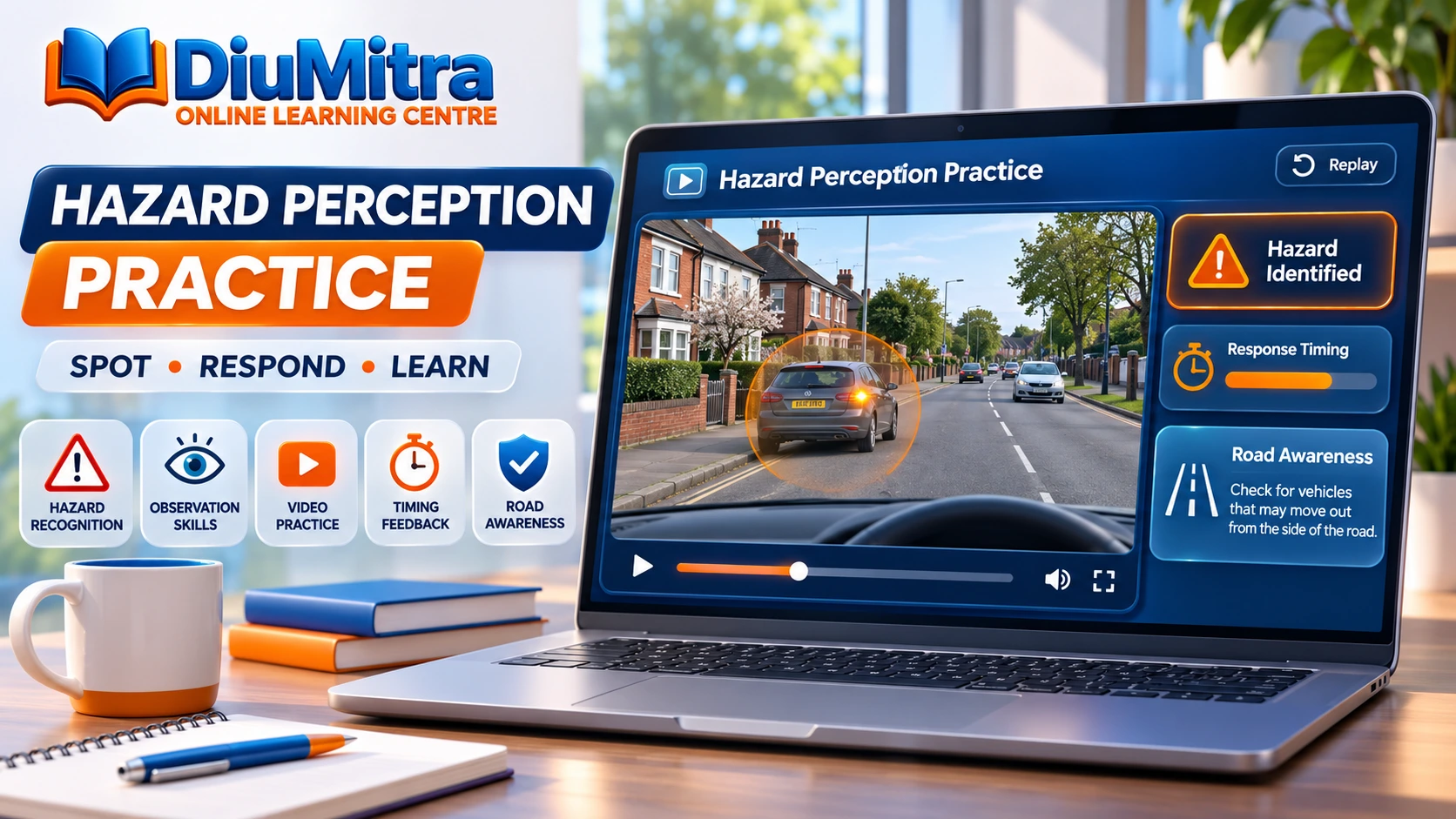
Start Hazard Perception Practice
Choose one short original training clip to practise spotting a developing hazard, or work through a 14-clip DiuMitra mock. Review your timing and improve your awareness with independent training activities.
Watch each short, stylised video scene. Press Spot hazard when a road situation begins to develop and you would need to consider changing speed or direction. Follow the player’s instructions for replay, feedback and submission.
Hazard Perception Practice
Practise recognising developing hazards using original DiuMitra synthetic road scenes. Click as soon as a situation starts to develop and you may need to change speed or direction.
Single-clip training
Practise one random clip and review your score and hazard timing immediately afterwards.
14-clip hazard mock
Complete all 14 clips without replay. One clip contains two developing hazards. Feedback is shown after submission.
If DiuMitra practice is unavailable, use the official GOV.UK free hazard-perception practice clips instead. The official service currently offers three free practice clips.
What Is a Developing Hazard?
The official test distinguishes something that might become a problem from something that is already changing and may require you to act. Understanding that transition is central to hazard perception.
Potential hazard
A parked vehicle may require attention, but if nothing is changing, you may not yet need to alter speed or direction.
Developing hazard
The vehicle indicates and begins pulling away. You may now need to slow down or change position to remain safe.
Timely response
Recognise the change promptly and make one genuine response. The official test awards more points for recognising developing hazards early.
The parked-car example follows the distinction used in the official GOV.UK explanation. Always prioritise safe judgement on the road, rather than treating a training click as a driving instruction.
How the DiuMitra Hazard Player Works
Explore two ways to practise: a short clip with timing feedback, and a 14-clip mock with a combined training score. Both are independent DiuMitra activities, not official DVSA tests.
Single-clip training
Start one randomly selected short clip, spot the developing hazard and review the feedback timeline after the clip. Use this mode to understand why the response was early, late or unscored.
- Short independent synthetic video
- Feedback on hazard timing
- Another practice attempt after completion
Full DiuMitra mock
Work through 14 synthetic training clips without replay, including a scene with two developing hazards. Review the combined result and missed hazards after submitting.
- 14 short synthetic clips; 15 scored hazards
- Up to five training points per hazard
- 44/75 configured practice target
DiuMitra clips are short, stylised learning simulations, typically around 10 seconds each. They do not match the realism or duration of the official test clips; reaching the practice target is not an official DVSA pass.
Three Steps to Better Hazard Timing
Use the short exercises to develop observation rather than clicking at random. A high score on a synthetic clip is only one part of learning safe hazard awareness.
Scan the whole scene
Look for side roads, parked vehicles, crossings and road users whose movement might change. Avoid fixing your attention on one object.
Notice the change
Respond as the situation develops into something that may require braking or steering. Do not click continuously or in a regular rhythm.
Review the evidence
Use the feedback timeline to identify what changed and when. Return to the related road rule before moving to a different scenario.
Can You Identify the Developing Hazard?
These original written scenarios are for understanding and discussion. They are not a replacement for watching moving hazard-perception clips or the official timing exercise.
A child near a parked car
You notice a child on the pavement beside a parked vehicle. The child then steps towards the carriageway.
When does the risk develop?
The child moving towards the road creates an immediate change that may require slowing down or stopping safely. Stay alert even before that movement.
A cyclist beside a junction
A cyclist is travelling near the kerb while you approach a left turn. The cyclist continues straight ahead.
What should you recognise?
Turning across the cyclist’s path may create a dangerous conflict. Observe, slow as needed and do not cut across the cyclist.
Traffic suddenly slows
Vehicles are moving normally ahead. The lead vehicle’s brake lights illuminate and the queue begins slowing.
When should you respond?
The developing reduction in speed signals the need to assess following distance and slow in good time. Look beyond the nearest vehicle.
DiuMitra Practice vs the Official GB Hazard Test
Both support learning, but the format, media and status of results are different. The official figures below apply to the Great Britain car theory test, not to DiuMitra’s own assessment.
| Feature | DiuMitra practice | Official GB car hazard test |
|---|---|---|
| Media | Original short stylised synthetic road clips | Official road-scene video clips |
| Session format | One practice clip or a 14-clip training mock, when enabled | 14 clips, with one containing two developing hazards |
| Scoring | Plugin practice scores and feedback | Up to five points per developing hazard |
| Pass result | Training target only; no official qualification | 44 out of 75 required for the car hazard-perception component |
| Provider | Independent DiuMitra Online Learning Centre | Official DVSA theory-test process |
What Happens in the Official Hazard Perception Test?
The official Great Britain car theory hazard-perception part shows 14 clips of everyday road scenes. One clip contains two developing hazards, giving 15 scored hazards in total.
Key official car-test rules
- Up to five points are available for recognising each developing hazard promptly.
- The hazard-perception pass mark for cars is 44 out of 75.
- You do not lose points merely for an incorrect click, but continuous or patterned clicking can result in no score for that clip.
- The official test permits only one viewing of each clip and does not let you change responses afterwards.
Read GOV.UK’s current hazard-perception instructions for the complete rules and examples.
Prepare Your Device and Practice Responsibly
For the best experience, use an up-to-date browser with video playback and a reliable internet connection. If a training clip does not load, you can still use the official resources linked below.
For learners
- Use a stable internet connection and a recent browser with video playback.
- Keep the video in view and use the accessible transcript if you need to follow the scenario in words.
- If you need formal reasonable adjustments, follow official GOV.UK arrangements rather than relying on DiuMitra settings.
- Do not use synthetic practice scores as evidence that you will pass the official test.
Availability and privacy
- Available activities may change as training material is updated.
- If practice is temporarily unavailable, try the official GOV.UK example clips linked below.
- Where an account is used, saving results and resuming an activity depend on your access permissions.
- Your browser may temporarily remember a session reference so you can resume an activity.
Official Hazard Perception Practice and Guidance
Use authoritative resources alongside DiuMitra training. Current official requirements may change, and the three free GOV.UK demonstration clips are the best way to compare the independent mock with the official practice experience.
For reading rules and answering multiple-choice questions, use DiuMitra’s Driving Theory Study Course and the separate Driving Theory Practice Tests page. This hazard page is reserved for recognising developing road situations.
Hazard Perception Practice FAQs
Clear answers about clip timing, scoring, official test rules and DiuMitra training access.
Watch the Road. Spot the Change. Learn Why.
Start with original hazard-perception practice, learn from the timing feedback, then compare your skills using GOV.UK’s official demonstration clips. Continue with the driving-theory study lessons and multiple-choice practice when you are ready.
DiuMitra is an independent educational provider, not the DVSA or a government examination service. No test result or licence outcome is guaranteed.