

BMI vs body fat compares two different measurements. BMI uses height and weight to screen for weight-related health risk, while body-fat percentage estimates how much of your body mass is fat. In 2026, UK guidance still uses BMI, but recommends adding waist-to-height ratio and personal context rather than treating any single number as a diagnosis.
BMI vs Body Fat: Which Measure Is More Useful?
BMI is a simple screening measure and remains useful in UK healthcare, but it cannot separate muscle from fat or show where fat is stored. Body-fat percentage gives extra body-composition information, yet accuracy depends on the measurement method. For many adults, BMI plus waist-to-height ratio provides a more practical health-risk picture.
Checked August 2026: updated against current NHS and NICE overweight, obesity and central-adiposity guidance, including NICE NG246 as updated in January 2026.
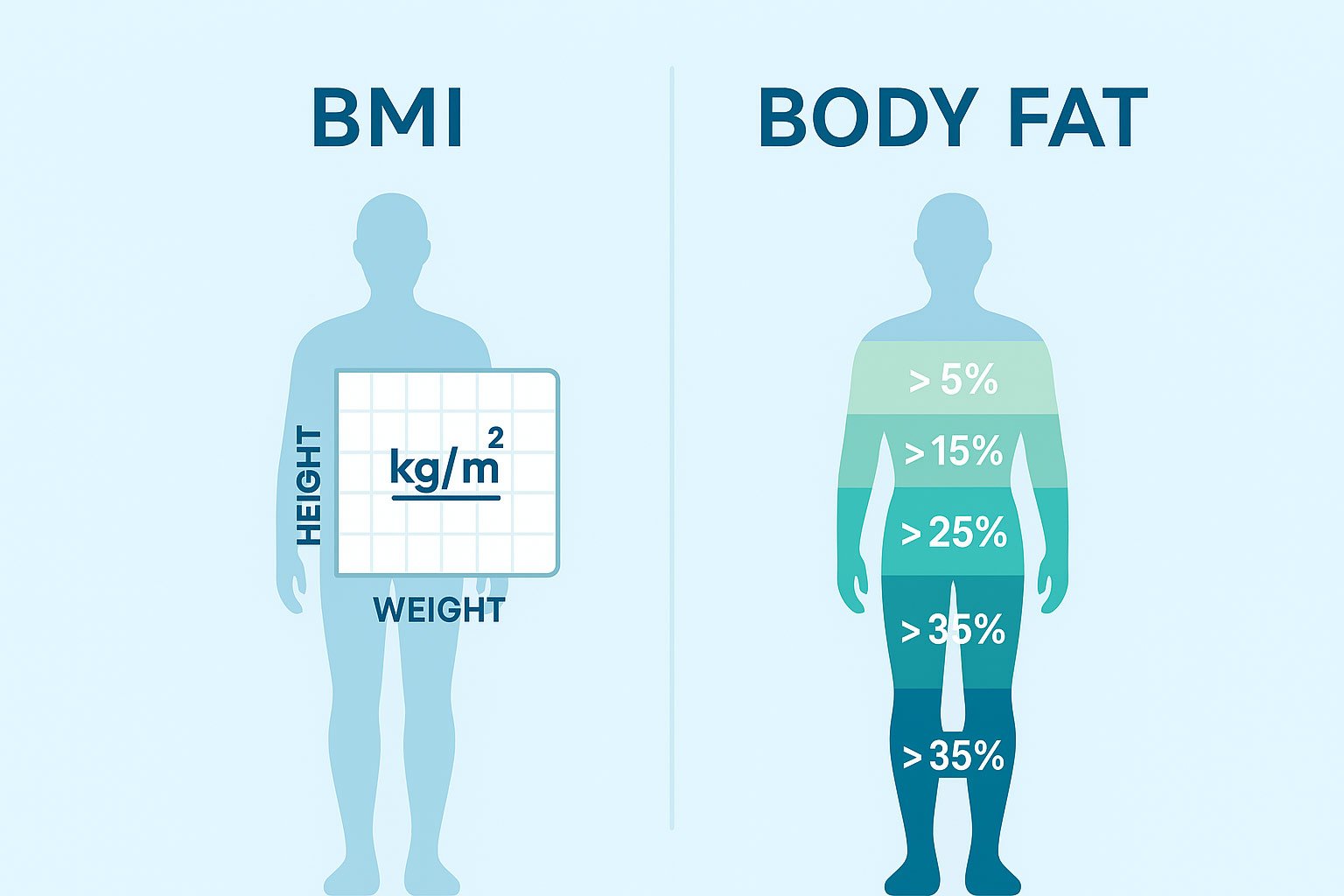
BMI vs Body Fat: The Difference in One Table
| Question | BMI | Body-fat percentage |
|---|---|---|
| What does it use? | Height and weight | An estimate of fat mass compared with total body mass |
| Does it separate muscle from fat? | No | It aims to, but the estimate depends on the method used |
| Is it used in UK clinical guidance? | Yes, as a practical measure of overweight and obesity | Not as the main NICE screening measure for general adiposity |
| Can it show abdominal fat? | No | Not reliably from a single whole-body percentage |
| Useful for tracking? | Useful for broad weight trends | Potentially useful for body-composition trends if measured consistently |
| Main limitation | Cannot distinguish fat from muscle or show fat distribution | Different devices and techniques can give different results |
What Is BMI and What Does It Actually Measure?
Body Mass Index (BMI) is calculated from an adult’s weight and height. It does not directly measure fat, muscle, bone or fitness. Its value is that it provides a quick, standardised way to classify weight relative to height and identify when further assessment may be useful.
BMI = weight in kilograms ÷ height in metres²For most adults, NICE classifies BMI 18.5 to 24.9 as healthy weight, 25 to 29.9 as overweight, 30 to 34.9 as obesity class 1, 35 to 39.9 as obesity class 2, and 40 or above as obesity class 3. These categories are screening thresholds rather than a complete health assessment.
Why BMI Thresholds Are Lower for South Asian Adults
This matters for many DiuMitra readers. NICE says people from South Asian, Chinese, other Asian, Middle Eastern, Black African and African-Caribbean backgrounds can develop cardiometabolic risk at a lower BMI. For these groups, NICE uses BMI 23 to 27.4 for overweight and 27.5 or above for obesity as practical thresholds.
The NHS adult BMI calculator asks about ethnic background for this reason and warns that BMI cannot distinguish muscle from fat.
What Is Body-Fat Percentage?
Body-fat percentage is the estimated proportion of your total body mass that is fat mass. The remaining mass includes muscle, bone, organs, water and other tissues. Two people with the same BMI can still have different proportions of fat and lean tissue.
That does not make every body-fat number automatically more accurate than BMI. Results depend on the method, device and measurement conditions, so smart scales, skinfolds and DXA can disagree.
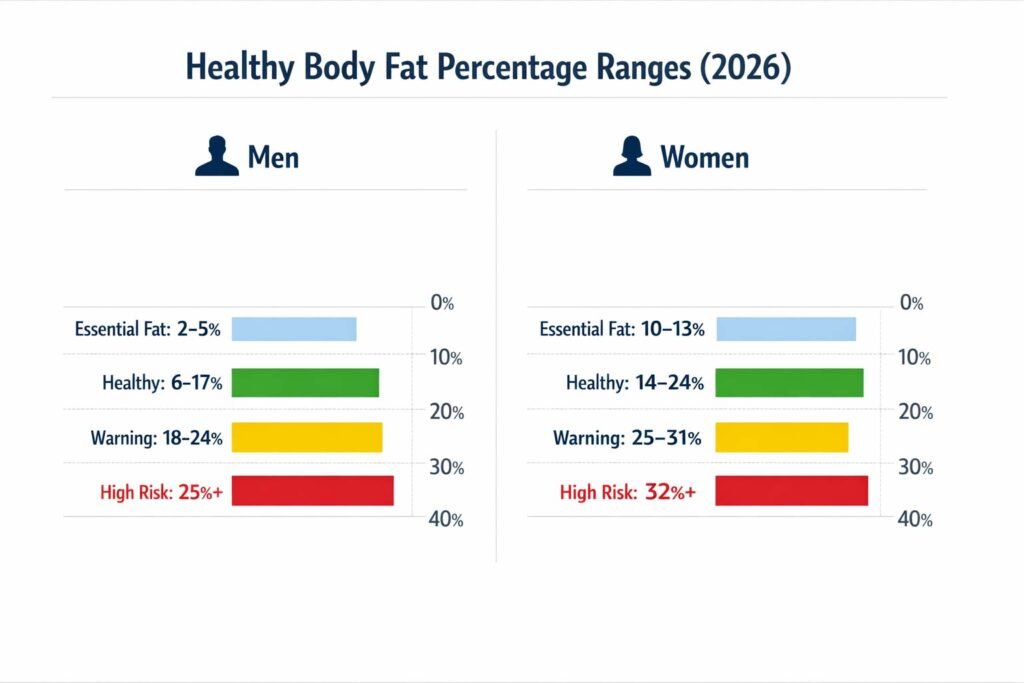
How Body-Fat Percentage Is Measured in 2026
Bioelectrical impedance estimates body composition from electrical properties of the body. Hydration, device design and prediction equations can affect the result.
Calipers estimate subcutaneous fat at selected sites. Repeated measurements can be useful when taken consistently by someone with good technique.
DXA can estimate fat mass, lean soft tissue and bone mineral. It is widely used as a reference technique, but it is not error-free and results can vary by scanner and protocol.
Waist, neck, hip or other body measurements can be used in equations to estimate composition. They are practical estimates rather than direct measurements of all body fat.
2026 research reinforces a practical point: body-composition methods can correlate well while still disagreeing for an individual. For tracking, using the same method under similar conditions is usually more meaningful than comparing different devices.
Why BMI Can Be Misleading
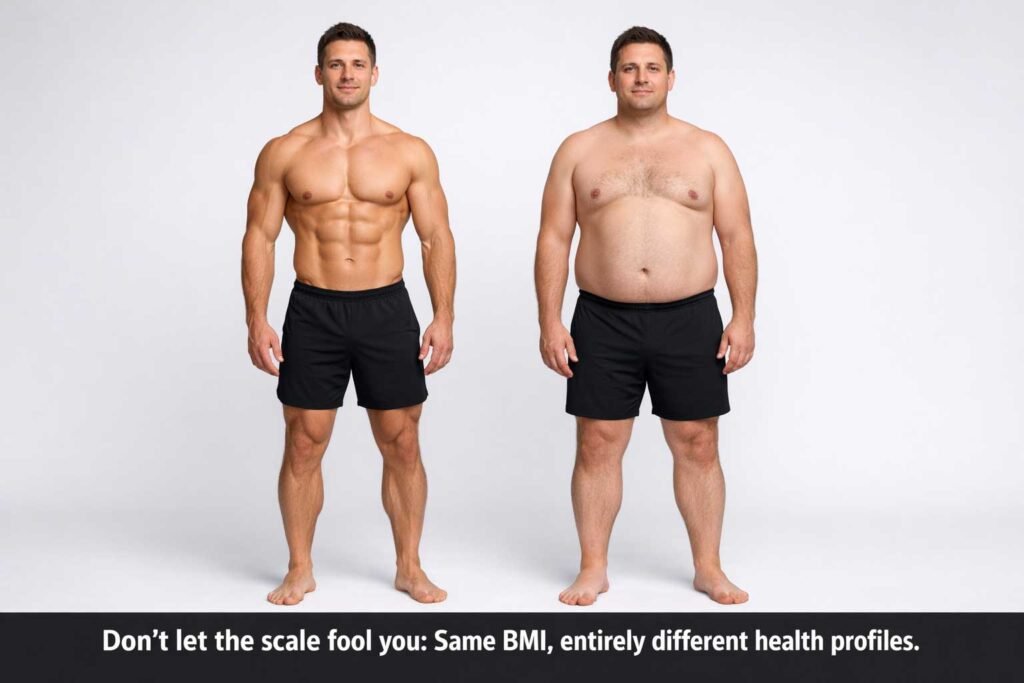
A muscular person may have a high body weight for their height even though a large proportion of that weight is lean tissue.
Someone can have a BMI in the healthy range but still carry more fat around the waist, which is why waist-to-height ratio can add useful information.
NICE uses lower overweight and obesity thresholds for South Asian and several other ethnic backgrounds.
NICE advises caution in adults aged 65 and over because comorbidities, functional capacity and body-composition changes affect interpretation.
The 2026 Measure Many People Miss: Waist-to-Height Ratio
For adults with a BMI below 35, NICE recommends measuring waist-to-height ratio as well as BMI. This gives a practical estimate of central adiposity—fat carried around the waist—which BMI cannot show directly.
| Waist-to-height ratio | NICE classification | Plain-English interpretation |
|---|---|---|
| 0.4 to 0.49 | Healthy central adiposity | No increased health risk identified from central adiposity |
| 0.5 to 0.59 | Increased central adiposity | Increased health risk |
| 0.6 or above | High central adiposity | Further increased health risk |
NICE’s simple message: try to keep your waist measurement to less than half your height.
The NHS also provides a waist-to-height calculator and says it should be used alongside BMI, not as a diagnosis. Pregnancy, eating disorders and some conditions affecting height need appropriate professional guidance.
Which Measure Should You Track?
| Your goal | Useful measure | Why |
|---|---|---|
| Quick adult weight screening | BMI | Simple, standardised and used in NHS/NICE guidance |
| Check abdominal fat risk | BMI + waist-to-height ratio | Gives extra information about central adiposity when BMI is below 35 |
| High muscle mass | BMI + waist-to-height ratio + context | BMI alone can overestimate adiposity in muscular adults |
| Track body-composition changes | Body-fat estimate using the same method | Can show trends that scale weight or BMI alone may miss |
| Clinical concern or symptoms | Professional assessment | No calculator or body-composition device can diagnose a health condition |
Two Examples: Same BMI, Different Context
Imagine two adults who are both 1.75 m tall and weigh 80 kg. Their BMI is about 26.1. That number tells you their weight relative to height, but it does not tell you why they weigh 80 kg.
A strength-trained adult may have a larger proportion of muscle. BMI can still fall in the overweight range even though central adiposity is low.
Another person can have the same BMI with less muscle and more fat around the waist. Waist-to-height ratio and broader health assessment can reveal information BMI alone does not show.
The updated 2026 approach is therefore more useful than saying “BMI is wrong” or “body fat is always better”. The measurements answer different questions.
How to Use the DiuMitra BMI Calculator Sensibly
- Enter current height and weight accurately. Small input errors can change the category near a threshold.
- Use the result as a screening number. It is not a diagnosis of fitness, body fat or disease.
- Consider ethnic-background thresholds. South Asian adults can face weight-related risk at a lower BMI.
- Add waist-to-height ratio where appropriate. This can provide more information about central adiposity.
- Look at trends, not one isolated day. Meaningful change is usually easier to interpret over time.
If You Want to Change Your Weight or Body Composition
Calculators can help you understand measurements, but they should not dictate an aggressive diet or exercise plan. Sustainable changes usually involve balanced eating, regular activity, appropriate strength work and adequate sleep.
If you are pregnant, have a medical condition, take medicines that affect weight, have unexplained weight change or have concerns about disordered eating, seek appropriate healthcare advice rather than relying on calculators alone.
Official and Scientific Sources for 2026
Check These Sources for Current Guidance
Frequently Asked Questions About BMI vs Body Fat
Start With BMI, Then Put the Number in Context
Calculate your BMI, compare it with waist-to-height ratio where appropriate, and remember that body-fat readings are estimates that depend on the method used. Use trends for general self-monitoring and seek qualified healthcare advice when you need an individual assessment.
Health information disclaimer: This page and DiuMitra calculators provide general educational information only. They are not medical devices, do not diagnose health conditions and do not replace individual advice from a GP, pharmacist, dietitian or other qualified healthcare professional.
