
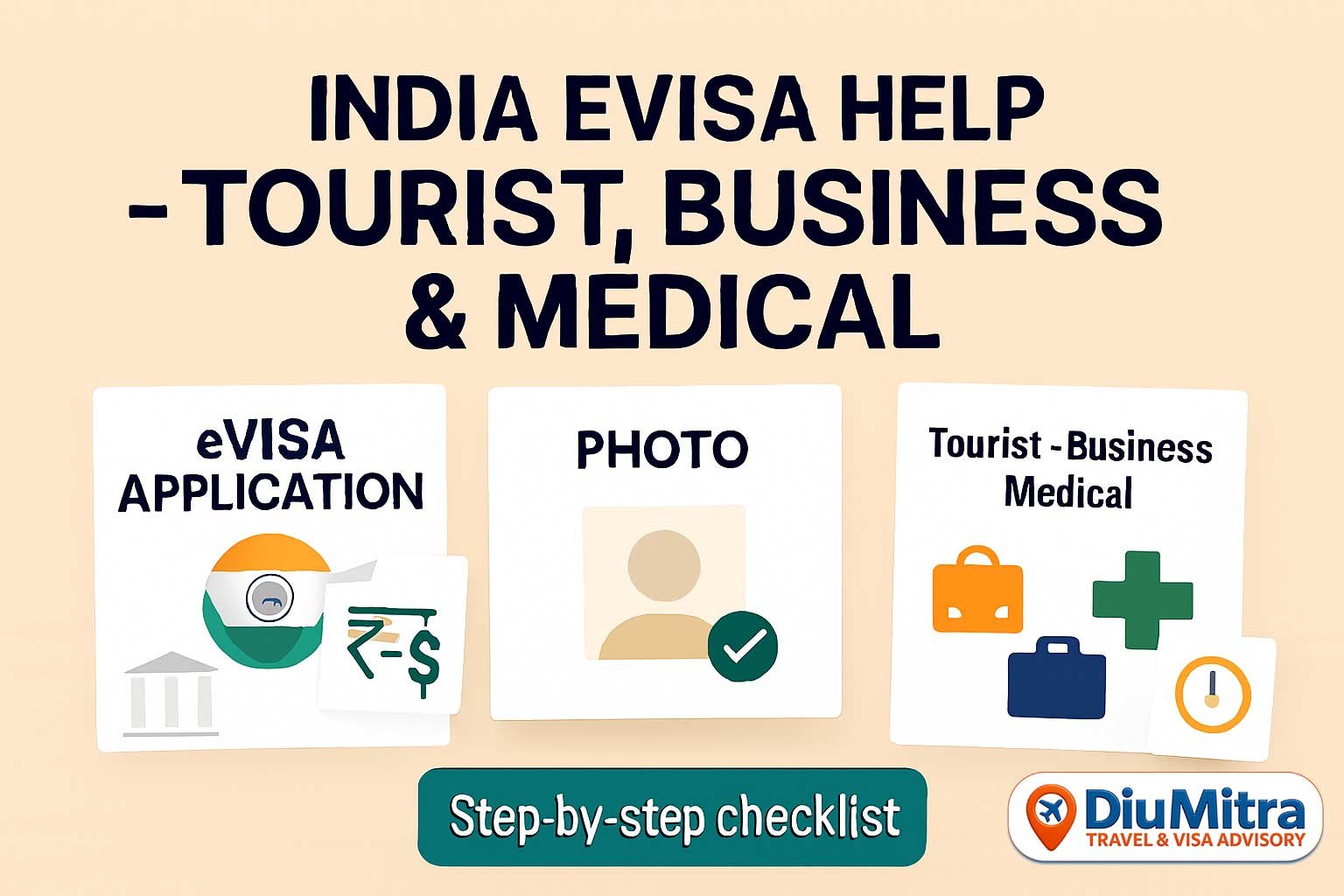
To apply for an India eVisa from the UK, you must complete the official online application at least 4 to 30 days before travel (depending on the category). You require a digital photo (JPEG), a scanned bio-page of your passport (PDF), and category-specific documents like a business card or hospital letter. The process typically takes 72 to 96 hours for approval.
Key Takeaways
- Passport Validity: Must have at least 6 months validity and 2 blank pages.
- Photo Rules: 2×2 inch, white background, no shadows, no spectacles.
- Categories: Choose correctly between Tourist (1-month, 1-year, 5-year), Business, or Medical.
- Avoid Scams: Only use the official government portal; DiuMitra provides advisory support to ensure your data is correct before submission.
Introduction: Navigating the UK-India eVisa Landscape
The connection between the UK and India has never been stronger. Whether you are heading to the tech hubs of Bengaluru for business, the spiritual retreats of Rishikesh, or seeking world-class healthcare in Delhi, the India eVisa is your primary gatekeeper.
However, the digital application remains one of the most meticulous processes globally. A single pixel error in a photo or a mismatched middle name can lead to immediate rejection. At DiuMitra, we empower your journey by providing the clarity and community support needed to navigate these bureaucratic hurdles with confidence.
While you prepare for your upcoming trip to India, it is equally important to ensure your UK residency status is up to date. If you currently hold a physical BRP, remember that the UK is moving to a digital-first system. Ensure your status is secure by checking our BRP to eVisa Transition Guide before you travel.
Understanding the Three Main eVisa Categories
Choosing the wrong category is the number one cause of entry refusal. Here is the 2026 breakdown of the most common visas.
A. The Tourist eVisa (e-Tourist Visa)
Intended for recreation, sightseeing, casual visits to friends or family, and short-term yoga programmes.
- 30-Day Duration: Double entry, non-extendable.
- 1-Year / 5-Year Duration: Multiple entries. You can stay for up to 180 days per calendar year.
- Key Document: Scanned Bio Page of Passport.
B. The Business eVisa (e-Business Visa)
For those attending technical/business meetings, setting up industrial ventures, or participating in trade fairs.
- Validity: Up to 1 year with multiple entries.
- Key Documents: Copy of Business Card and an Invitation Letter from the Indian company (on their letterhead).
C. The Medical eVisa (e-Medical Visa)
For seekers of medical treatment from recognised hospitals in India.
- Validity: 60 days from the date of first entry (Triple entry allowed).
- Key Document: A letter from the relevant hospital in India on its letterhead, specifying the date of admission/treatment.
Comparison Table: Which eVisa Do You Need?
Feature | e-Tourist | e-Business |
|---|---|---|
Best For | Holidays/Family | Meetings/Trade |
Max Stay | 180 days/year | 180 days total |
Entries | Multiple (1/5 yr) | Multiple |
Primary Doc | Passport Scan | Business Card |
The Strict Photo and Document Specifications
Technical errors account for nearly 60% of delayed India eVisa applications. In 2026, the AI-driven scanning systems of the Indian Bureau of Immigration are more sensitive than ever.
The Photo Checklist
- Format: JPEG
- Size: Minimum 10 KB, Maximum 1 MB.
- Dimensions: Minimum 350 x 350 pixels.
- Background: Plain white or light-coloured.
- Expression: Neutral expression, eyes open, no glasses (even prescription glasses are frequently flagged).
The Passport Bio-Page Checklist
- Format: PDF
- Size: Minimum 10 KB, Maximum 300 KB.
- Clarity: All text, including the Machine Readable Zone (MRZ) at the bottom, must be legible.
Expert Tip: Use a professional PDF compressor. If the file is blurry, the visa officer will reject it.
Step-by-Step Application Roadmap
Applying for an India eVisa from the UK requires patience. Follow these steps to ensure a smooth “Granted” status.
Step 1: Initial Registration
Visit the official portal. You will receive a Temporary Application ID. Write this down immediately. If your session times out (which happens often), you will need this ID to retrieve your data.
Step 2: Personal Details
Ensure your name exactly matches your passport. If your passport says “Jonathan James Smith,” do not write “Jon Smith.”
- Visible Identification Marks: If you have a permanent tattoo or scar, list it. If not, write “NONE.”
Step 3: Passport Details
Enter your passport number, place of issue, and expiry date. Double-check for typos.
Step 4: Contact and Family Details
You will need to provide your parents’ names and birthplaces. Even if deceased, this information is mandatory for the Indian government’s records.
Step 5: Occupation Details
Be specific. Instead of “Business,” write “Software Engineer” or “Marketing Consultant.” If you are a journalist or member of the police/military, expect additional scrutiny and potentially a longer processing time.
Step 6: References
You must provide a reference in India (hotel name and address) and a reference in the UK (friend, employer, or relative).
💡 DiuMitra Pro-Tip: Don’t let your travel plans be disrupted by outdated UK status. As you manage your travel documents, take a moment to confirm you have transitioned to your new UKVI digital status. Need help with your UKVI account? Click here for guided BRP to eVisa support.
Avoiding the “Payment Failed” Trap
The Indian eVisa payment gateway is notorious for rejecting UK credit and debit cards. This is often due to 3D Secure authentication failures or the bank flagging an international transaction to India.
How to fix it:
- Use PayPal: If available, it is often the most stable method for UK users.
- Notify Your Bank: Call your bank before paying to “white-list” the transaction.
- The Three-Strike Rule: If you fail payment three times, the application may lock. You might need to start a fresh application.
Common Mistakes to Avoid
Based on hundreds of advisory sessions at DiuMitra, these are the most frequent pitfalls:
- Applying too early/late: You can apply up to 120 days in advance, but no later than 4 days before travel.
- Misunderstanding “Date of Issue”: For the 30-day Tourist visa, the “validity” starts the day it is issued, not the day you arrive.
- Inputting “UK” instead of “United Kingdom”: Always select the full country name from the dropdown.
- Failing to Print: You must carry a physical printed copy of the “Electronic Travel Authorisation” (ETA). Digital copies on phones are often not accepted at Indian immigration counters.
The DiuMitra Difference: Cultural Nuance
Traveling from the UK to India is more than just a flight; it’s a shift in pace and culture. We understand that for the British Indian diaspora, this trip often involves emotional family reunions. For business travellers, it involves navigating the unique etiquette of Indian corporate life.
DiuMitra isn’t just a checklist. We are your community. We offer advisory services to review your documents and ensure your application reflects your true intent, reducing the anxiety of the “Pending” status.
Frequently Asked Questions
Conclusion: Your Journey Starts Here
Securing your India eVisa is the first successful step of your Indian adventure. While the form may be long and the rules strict, following this guide ensures you are prepared for every question and upload requirement.
Securing your India eVisa is the first successful step of your Indian adventure. And while you are getting your paperwork in order, don’t overlook your UK residency requirements. Explore our BRP to eVisa Transition Support to ensure you can travel and return to the UK with complete peace of mind.
Ready to start your journey?
⚠️ Disclaimer: All services are offered on an advisory basis only. We do not act as legal, immigration, or financial representatives, and we do not guarantee outcomes. Applications and submissions remain the responsibility of the individual.