

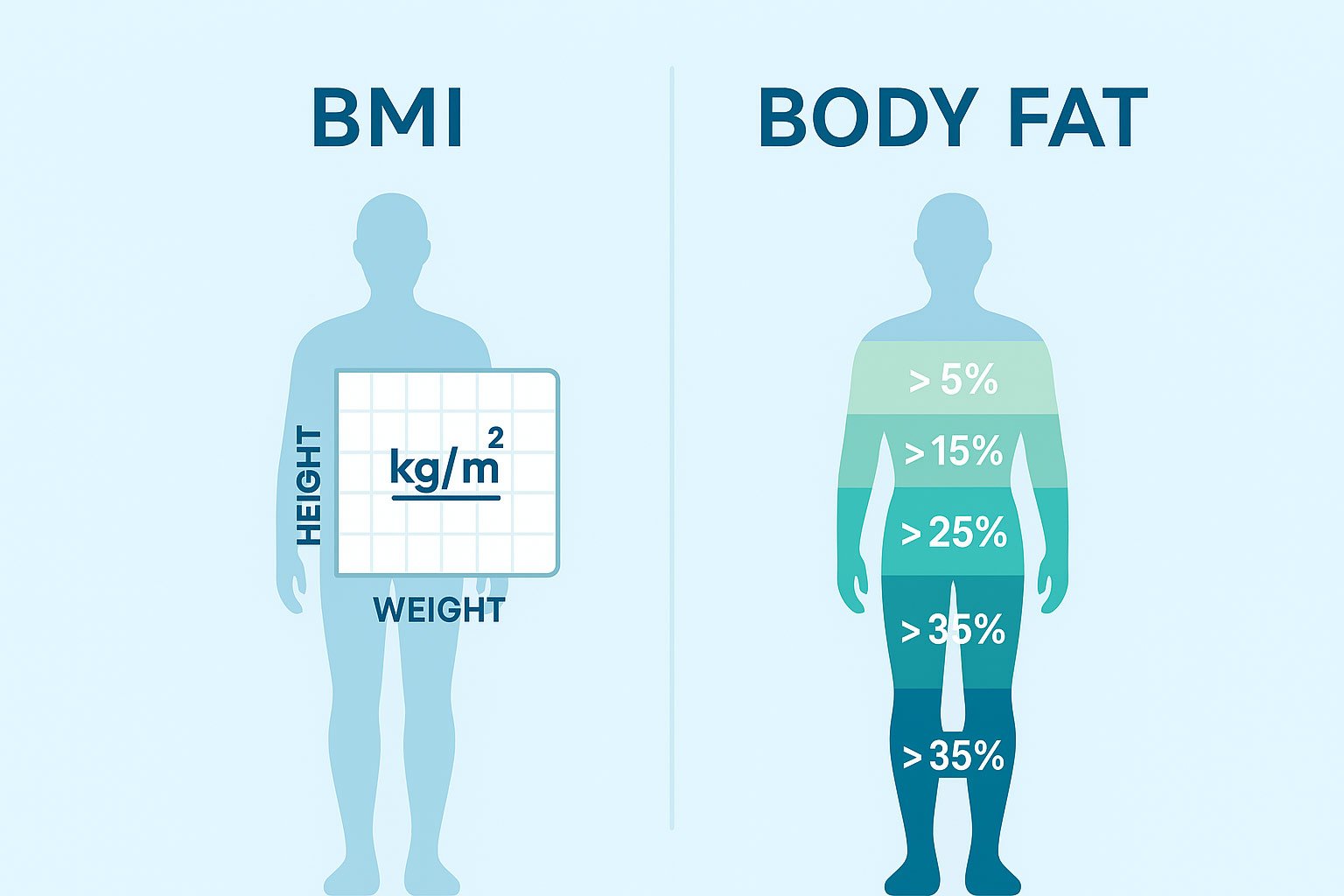
When it comes to understanding your health, weight alone doesn’t give you the full picture. Two of the most common ways to assess overall body composition and health risks are BMI (Body Mass Index) and Body Fat Percentage. While people often confuse the two, they are very different measurements — and each provides unique insights into your health.
In this in-depth 2026 guide, we’ll explain exactly what BMI and body fat percentage measure, how they’re calculated, when to use each, and which one gives a more accurate picture of your health. We’ll also give you practical tips, examples, and free tools you can use, including the:
Feature | BMI (Body Mass Index) | Body Fat Percentage |
|---|---|---|
What it measures | Total weight relative to height | Actual percentage of fat vs. muscle |
Accuracy | General estimate (can be wrong) | Highly accurate body composition |
Considers Muscle? | No (Muscle is “heavy” on BMI) | Yes (Distinguishes muscle from fat) |
Best Used For | Quick population screening | Personal fitness & health tracking |
2026 Verdict | Use as a starting point | The “Gold Standard” for health |
👉 BMI Calculator
👉 Calorie Calculator
Let’s get started.
1. What Is BMI? (Body Mass Index Explained)
BMI (Body Mass Index) is a numerical score based on two factors:
- Your height
- Your weight
The formula is: BMI=weight (kg)height (m)2\text{BMI} = \frac{\text{weight (kg)}}{\text{height (m)}^2}BMI=height (m)2weight (kg)
BMI has been used globally for decades as a screening tool to identify potential health risks associated with being underweight, overweight, or obese.
BMI Categories
BMI Range | Category |
|---|---|
Below 18.5 | Underweight |
18.5 – 24.9 | Normal weight |
25 – 29.9 | Overweight |
30+ | Obese |
BMI is quick and easy to calculate using our free tool:
👉 Use the BMI Calculator: https://diumitra.com/tools/bmi-calculator/
Why People Use BMI
- Very quick to calculate
- Useful for population health studies
- Helps identify general risk levels
But BMI has limitations — and that’s where body fat percentage becomes more useful.
📊 Get Your Instant Health Snapshot
Don’t guess your numbers. Use our Free BMI Calculator to see where you stand and get a personalized guide on your next steps.
2. What Is Body Fat Percentage? (Much More Accurate)
Body Fat Percentage measures the actual proportion of your body made up of fat compared to everything else (muscle, water, bone, and organs).
This makes it a direct measure of body composition — far more precise than BMI.
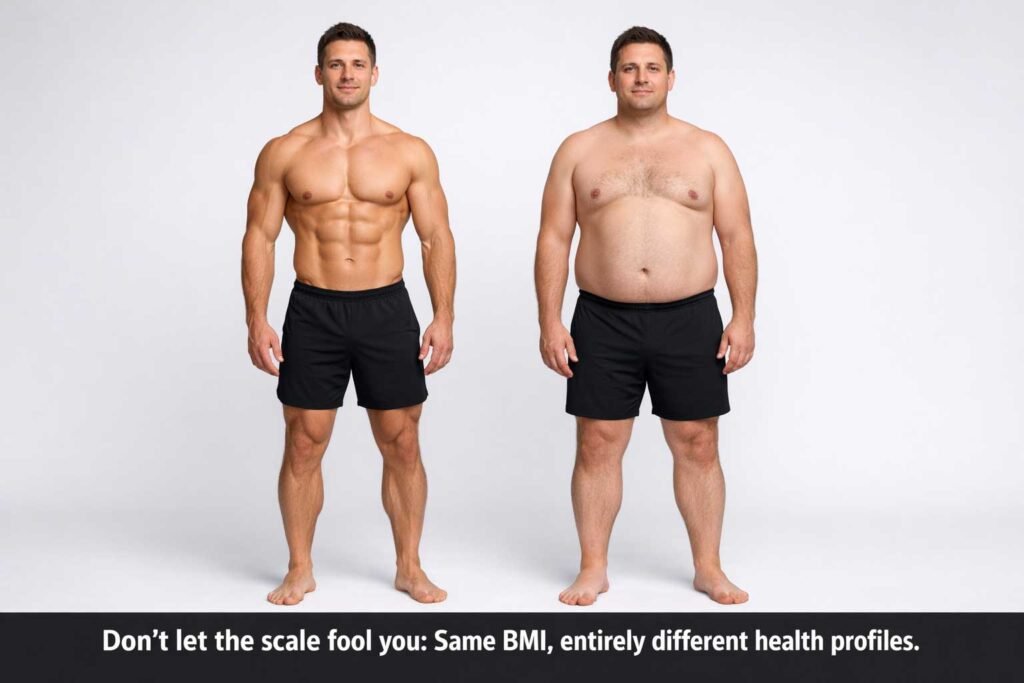
Two people with the same BMI can have very different body fat levels.
For example:
- A muscular athlete may have a BMI in the “overweight” range but very low body fat.
- Someone with low muscle mass may appear “healthy” on BMI but have high body fat (a condition known as TOFI — thin outside, fat inside).
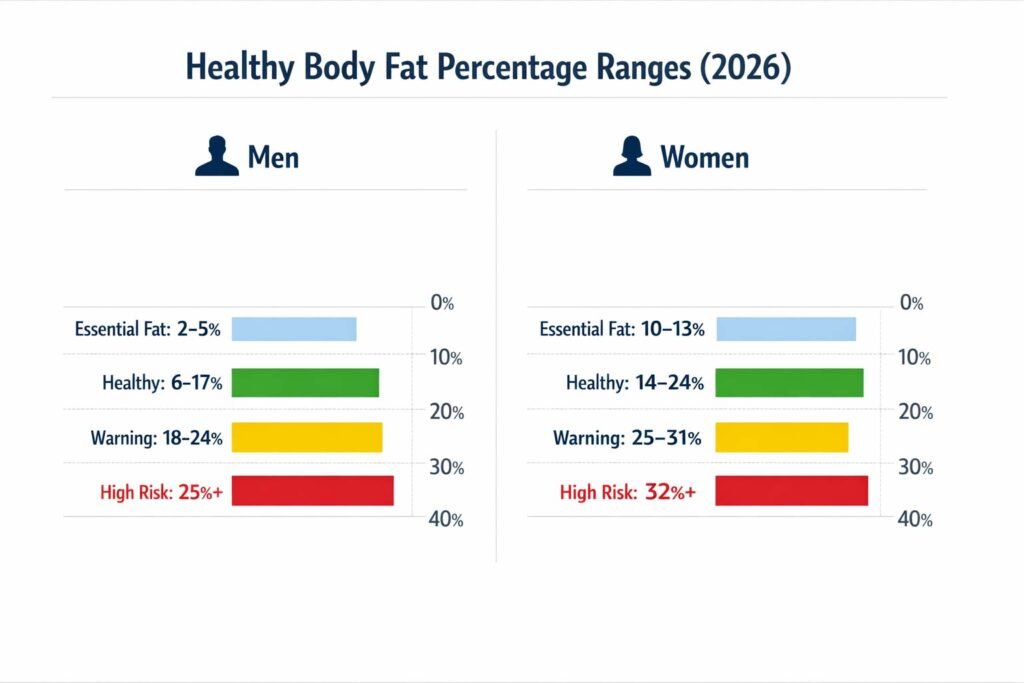
Healthy Body Fat Percentage Ranges
Age | Men | Women |
|---|---|---|
20–39 | 8–19% | 21–32% |
40–59 | 11–21% | 23–33% |
60–79 | 13–24% | 24–35% |
These ranges are more nuanced and health-focused than BMI.
3. How Body Fat Percentage Is Measured
Body fat can be measured using several methods. Some are highly accurate; others are quick estimates.
1. DEXA Scan (Most Accurate)
A medical-grade scan that uses X-ray technology to measure bone density, fat mass, and muscle mass.
Accuracy: ★★★★★
2. Body Fat Calipers
A fitness professional pinches specific skin areas to estimate fat percentage.
Accuracy: ★★★★☆
3. Bioelectrical Impedance Scales (BIA)
Smart scales that send a small electrical current through the body.
Accuracy: ★★★☆☆
4. Navy Body Fat Formula
Uses neck, waist, height, and sometimes hip measurements.
Accuracy: ★★★☆☆
5. Visual Body Fat Comparison Charts
Good for rough estimation.
Accuracy: ★★☆☆☆
4. The Key Differences Between BMI and Body Fat Percentage
Here is a clear breakdown of how they compare:
Feature | BMI | Body Fat Percentage |
|---|---|---|
Measures what? | Height–weight ratio | Actual fat mass |
Accuracy | Low–moderate | High |
Considers muscle? | ❌ No | ✔️ Yes |
Considers gender? | ❌ No | ✔️ Yes |
Considers age? | ❌ No | ✔️ Yes |
Best for | Quick screening | Detailed health assessment |
5. Why BMI Can Be Misleading
BMI does not distinguish between muscle, fat, water, or bone. This creates several common problems:
1. Athletic People May Be Classified as “Overweight”
Muscle weighs more than fat.
So, fit individuals may have a high BMI even with low body fat.
Example:
- Athlete, 85 kg, 1.75 m
- BMI = 28 (Overweight)
- Body fat = 12% (Excellent)
BMI makes them appear unhealthy, even though they are fit.
2. Thin People May Be Classified as “Healthy” (TOFI)
TOFI = Thin Outside, Fat Inside
People who look slim but have high visceral fat (dangerous internal fat).
Example:
- Normal BMI (22)
- Body fat = 30%
- Low muscle mass, high internal fat
BMI misses this risk completely.
3. BMI Doesn’t Work Well Across All Populations
BMI was originally created based on European populations.
It doesn’t perfectly represent:
- Asian body types
- Athletes
- Elderly individuals
- Pregnant women
- People with certain medical conditions
6. Why Body Fat Percentage Is a Better Indicator of Health
Body fat percentage provides a clearer picture of:
- metabolic health
- hormonal health
- risk of cardiovascular disease
- risk of diabetes
- inflammation levels
- fitness levels
- long-term health outcomes
High body fat percentage increases risk of:
✔ Type 2 diabetes
✔ Heart disease
✔ Stroke
✔ High blood pressure
✔ Metabolic syndrome
✔ Sleep apnea
✔ Hormonal imbalance
Meanwhile, a healthy body fat percentage is linked to:
✔ Longevity
✔ Better mobility
✔ Higher energy levels
✔ Stronger metabolism
✔ Better fitness performance
7. How to Calculate Your BMI (Use the Free Tool)
Instead of doing the math manually, you can use:
👉 Free BMI Calculator
https://diumitra.com/tools/bmi-calculator/
Enter your height and weight — instant results.
The tool will also give:
- category
- healthy range guidance
- recommended next steps
8. Understanding Where BMI Does Have Value
Even though BMI is not perfect, it still has benefits:
1. Good for general population studies
Doctors use BMI to estimate risk at the population level.
2. Good for quick health screening
BMI gives a fast ballpark number.
3. Good for tracking weight trends
If your BMI changes significantly, it usually indicates real body changes.
9. When You Should Rely More on Body Fat Percentage
Body fat percentage is more useful when:
- you’re an athlete
- you’re strength training
- you’re trying to gain muscle
- you’re trying to monitor fat loss
- you have a normal BMI but low fitness
- you have a high BMI and want clarity
- you’re tracking physique progress
In all these cases, body fat gives more meaningful insights.
10. Body Fat vs BMI for Weight Loss: Which Should You Track?
If your primary goal is fat loss, tracking body fat percentage is far more useful.
Reasons:
✔ It shows fat loss even when weight stays the same
✔ It measures real progress
✔ It distinguishes between muscle gain and fat loss
✔ It motivates better long-term habits
BMI cannot do any of this.
BMI only tells you how heavy you are relative to your height.
If you want to understand your metabolism while losing fat, you can also use the:
This helps determine:
- your daily calorie needs
- how many calories to eat to lose fat
- how many calories to maintain your weight
11. How to Improve Your BMI and Body Fat Percentage
Here are the most effective proven methods.
1. Strength Training (3–4 Days Per Week)
Builds muscle while burning fat.
Lower body fat percentage → healthier physique.
2. Increase Daily Protein Intake
Aim for 1.6–2.2g per kg of body weight.
Protein increases satiety and supports muscle retention.
3. Improve Sleep Quality
Poor sleep increases hunger hormones (ghrelin) and fat storage.
4. Reduce Ultra-Processed Foods
These foods cause weight gain due to low nutritional density and high calories.
5. Use a Calorie Strategy (deficit or maintenance)
Calculate your daily calorie needs using:
👉 Calorie Calculator
https://diumitra.com/tools/calorie-calculator/
6. Add Daily Movement (7,000–10,000 steps)
Walking helps burn calories without overstressing the body.
12. Which Is More Important: BMI or Body Fat? (The Final Verdict)
If you want general health screening → BMI is fine
Quick. Simple. Population-based.
If you want accurate health and fitness insights → body fat is far superior
It tells you:
- fat mass
- muscle mass
- metabolic health
- hormonal balance
- real health risks
Best practice: Track both.
BMI for quick checks.
Body fat for meaningful detail.
13. Example Side-by-Side Comparison
Let’s compare two individuals with the same BMI.
Person A
- Weight: 80 kg
- Height: 175 cm
- BMI: 26.1 (Overweight)
- Body fat: 11%
- Physique: Muscular, athletic
BMI says unhealthy — but they are fit.
Person B
- Weight: 80 kg
- Height: 175 cm
- BMI: 26.1 (Overweight)
- Body fat: 30%
- Physique: Low muscle, high fat
BMI correctly identifies increased risk — but doesn’t tell the whole story.
14. Which One Should You Track in 2026?
Use BMI as a basic screening tool.
Use body fat percentage for:
- transformation tracking
- fat loss
- muscle building
- health improvement
- longevity goals
For weight, metabolism, and calorie control, also use:
👉 Calorie Calculator
https://diumitra.com/tools/calorie-calculator/