

How compound interest works is simple: once interest is added to a balance, future interest can be calculated on that larger balance. In the UK in 2026, the idea is most useful for understanding savings growth, AER, regular contributions, long-term projections and some forms of debt. Investments can also compound through reinvested returns, but those returns are not guaranteed.
How Does Compound Interest Work?
Compound interest means interest is added to your balance and later interest can be earned on both the original principal and previously added interest. Time, the annual rate, compounding frequency and additional deposits all affect the result. For UK savings accounts, compare AER because it already reflects compounding over a year.
2026 source check: MoneyHelper explains compound interest as earning interest on both the original amount and interest already added. Current GOV.UK guidance also sets the UK savings-tax and ISA rules described later in this guide.
What Is Compound Interest?
Compound interest is interest calculated on a balance that can include both your original principal and interest added in earlier periods. If the interest remains in the account, the base used for the next calculation can become larger, creating the familiar “interest on interest” effect.
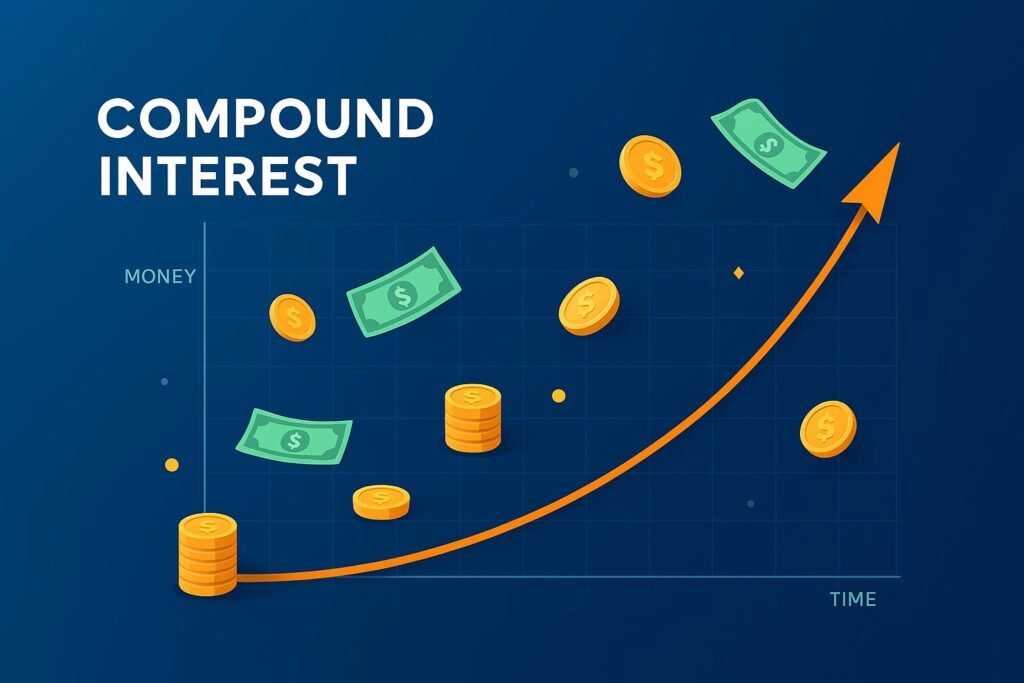
Compound growth is curved rather than linear because later periods can build on interest already added. This guide has been updated for UK readers in 2026.
The Four-Part Compounding Cycle
The calculation repeats as long as interest stays in the balance and the product continues to pay interest.
Your account or model begins with an initial balance.
The provider applies the relevant rate under the account terms.
If the interest remains in the account, the balance becomes larger.
Future interest can then be calculated on principal plus earlier interest.
Balance grows → interest is added → the next calculation can start from a larger balance
Simple Interest vs Compound Interest
| Type | How Interest Is Calculated | What Happens Over Time |
|---|---|---|
| Simple interest | Interest is calculated only on the original principal. | The interest amount is broadly linear if the rate and principal stay unchanged. |
| Compound interest | Interest can be calculated on principal plus earlier interest left in the balance. | Growth can accelerate because the calculation base can increase each period. |
For example, £1,000 earning 5% once a year becomes £1,050 after year one, £1,102.50 after year two and about £1,157.63 after year three if the rate stays constant and all interest remains in the account. With simple interest at the same rate, the balance would be £1,150 after three years.
The Compound Interest Formula
The standard future-value formula for a single starting balance is:
A = P(1 + r/n)ntA = future balance · P = principal · r = annual nominal rate as a decimal · n = compounding periods per year · t = number of years.
Real savings plans often include regular deposits, withdrawals, changing rates, tax or fees, so the formula above is only the starting point. The DiuMitra Compound Interest Calculator can model a starting amount plus periodic contributions and different compounding frequencies.
Worked Example: £5,000 Plus £100 a Month
As an illustration, £5,000 earning a constant nominal 5% a year with monthly compounding, plus £100 added at the end of each month for 10 years, grows to roughly £23,763. Of that, £17,000 is the starting balance plus contributions and the remainder is modelled growth. This assumes the rate never changes and ignores tax, fees and withdrawals.
Daily, Monthly or Annual Compounding: Why AER Matters
If the same nominal rate is compounded more frequently, the effective annual result is slightly higher because interest is added to the balance sooner. At a nominal 5% rate, annual compounding produces 5.00% over a year, monthly compounding is about 5.12%, and daily compounding is about 5.13% before tax or fees.
For UK savings accounts, however, the practical comparison is usually AER — Annual Equivalent Rate. AER already standardises the effect of compounding over a year, so a saver should not choose an account merely because it says interest is calculated or paid more frequently. Compare AER, access rules, bonuses, withdrawal limits and whether the rate is fixed or variable.
UK terminology: AER is used for savings. APR is primarily a borrowing-cost measure. “APY” is common in US material but is not the normal UK savings comparison term.
Compound Growth Calculator Example
Use this small educational calculator to see how principal, rate, time and compounding frequency interact. For regular deposits or more detailed modelling, use the full Compound Interest Calculator.
See Compound Growth Over Time
This model assumes a constant nominal annual rate, no withdrawals, no tax and no fees.
Your future balance, interest earned and effective annual rate will appear here.
Compound Interest in UK Savings Accounts
Savings accounts may calculate interest daily, monthly or on another schedule and may pay it monthly, annually or at maturity. What matters is the product terms and the AER. If interest is paid into the same account and stays there, it can contribute to future compound growth.
Fixed vs Variable Rates
A fixed-rate account keeps the stated rate for the agreed term, subject to its conditions. A variable rate can move. A long-term compound projection therefore becomes less certain when the underlying rate can change, even though the mathematics itself is straightforward.
Tax on Savings Interest in 2026
Compound growth is normally shown before tax. As at August 2026, GOV.UK says most people can receive some savings interest tax-free through the Personal Allowance, the starting rate for savings and/or the Personal Savings Allowance. The allowance depends on your Income Tax band.
Current Personal Savings Allowance for basic-rate taxpayers.
Current Personal Savings Allowance for higher-rate taxpayers.
Additional-rate taxpayers do not receive a Personal Savings Allowance.
The starting rate for savings can provide up to £5,000 of tax-free savings interest for people with sufficiently low other income; it reduces as other income rises and is unavailable once other income reaches £17,570. Your own tax position can differ, so use GOV.UK or HMRC rather than relying on a calculator for tax treatment.
Cash ISAs and the £20,000 ISA Allowance
Interest on cash held inside an ISA is tax-free. Current GOV.UK guidance says you can put up to £20,000 per tax year into ISAs, split across eligible ISA types if you choose. Tax-free status does not make every ISA the best savings account, so compare AER, access and product conditions as well as tax treatment.
Compound Growth in Investments Is Not Guaranteed Interest
Investments are often described as “compounding”, but the mechanism is different from a bank account paying a contractual interest rate. Shares, funds and pension investments can produce capital gains, dividends or other returns; if those returns are reinvested, later returns are applied to a larger investment value. The outcome can compound upward, but market values can also fall.
The Investment Calculator is useful for testing assumptions, not predicting a guaranteed future value. When you compare scenarios, reduce the assumed return to see how sensitive the result is and remember that past performance does not determine future returns.
Nominal Growth vs Real Growth After Inflation
A future balance can be much larger in pounds while having less purchasing power than the headline number suggests. Inflation reduces what money can buy. For long-term planning, compare the nominal projection with an inflation-adjusted or “real” value where possible.
Why Compounding Matters in Retirement Planning
Retirement projections combine contributions, time and assumed investment returns. Starting earlier gives contributions more time to participate in future growth, but that does not mean everyone should invest in the same way or use the same assumed return.
Use the DiuMitra Retirement Calculator to test different contribution, return and inflation assumptions. Treat the result as a planning scenario, not a promise of the pension pot or income you will receive.
When Compound Interest Works Against You
Compounding is not always positive. Some debts can add unpaid interest to the balance, meaning future interest is charged on a larger amount. A clear UK example is an interest roll-up lifetime mortgage: MoneyHelper explains that the interest is added to the mortgage balance and future interest is then calculated on the larger balance.
Credit cards, loans and other borrowing have their own interest and repayment rules. Do not assume every debt compounds in the same way. For borrowing comparisons, use the actual agreement and read the APR vs Interest Rate UK 2026 guide to understand why APR, fees and repayment behaviour matter.
The Rule of 72: A Fast Approximation
The Rule of 72 gives a rough estimate of how long a balance would take to double if it grew at a constant annual percentage rate: 72 ÷ annual rate ≈ years to double. At 6%, the shortcut gives about 12 years; at 8%, about 9 years.
It is only an approximation. It ignores changing rates, tax, fees, deposits and withdrawals, so use the full compound-interest formula or calculator when accuracy matters.
Common Compound Interest Mistakes
Five Mistakes to Avoid
Most misleading compound-interest projections come from assumptions, not the formula itself.
Use AER to compare UK savings accounts and keep borrowing APR separate.
Variable savings rates can move and investment returns are not fixed.
Charges and tax can reduce the amount that remains available to compound.
Reinvested investment returns can compound, but capital is at risk.
A large future nominal balance may have less real purchasing power.
Which DiuMitra Calculator Should You Use?
| Tool | Best For | Main Limitation |
|---|---|---|
| Compound Interest Calculator | Principal, compounding frequency, regular contributions and future value. | Assumes the rate and contribution pattern you enter; it cannot predict future rates or returns. |
| Savings Calculator | Projecting a savings balance or solving for contributions needed to reach a goal. | Tax, rate changes and account restrictions need separate consideration. |
| Investment Calculator | Testing long-term return, contributions and inflation scenarios. | Investment returns are uncertain and capital can fall. |
| Retirement Calculator | Modelling a future pension pot, inflation and an income target. | It is a projection, not regulated pension or investment advice. |
Compound Interest Planning Checklist
Before You Trust a Compound Growth Projection
Tick each item before using a future-value number for a real financial decision.
Official and Authoritative 2026 Sources
Frequently Asked Questions
Want to See What Compounding Could Do to Your Savings?
Use DiuMitra’s calculators to test different balances, rates, time periods and contributions. We can help explain the figures and signpost useful resources, but investment, pension and product recommendations should come from an appropriately authorised professional.
⚠️ Disclaimer: All services are offered on an advisory basis only. We do not act as legal, immigration, or financial representatives, and we do not guarantee outcomes. Any actions or applications taken based on our guidance are the sole responsibility of the individual. We connect you with relevant resources and trusted providers where possible, but all arrangements and submissions remain your responsibility.
